Prince George: The armpit of British Columbia or British Columbia’s best kept secret?!

I’ve heard both those descriptions thrown about to describe the city we’re currently calling home. You might say that Prince George is one of those industrial cities which divides opinion. Remember the airport customs official in this post who laughed at the idea of us moving there and then admitted he’d never visited?!

Rather than weigh in on the ‘armpit vs. best kept secret debate’. I’m going to explore whether Prince George lived up to my expectations. During the long, frustrating summer of 2020 and our two weeks in quarantine I shared a few posts (find them here) imagining what life in Prince George might be like. After rereading these posts recently I felt they needed an answer: did the the wildlife, city life and weather turn out as I expected?

. . .

1. Small adventures within the city

Art amongst the trees
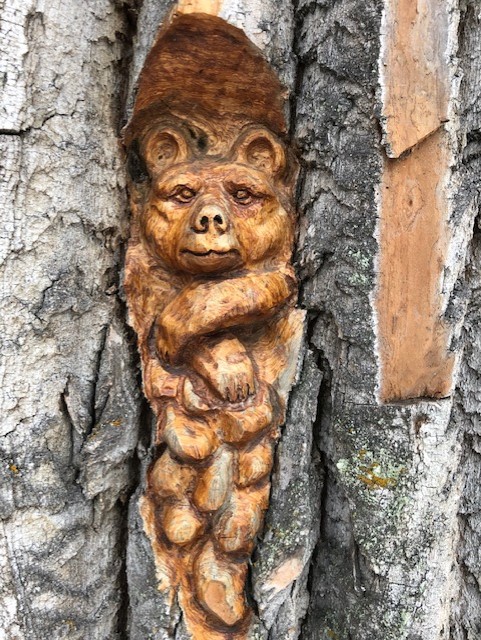
Cottonwood Island deserves it’s place at #2 on TripAdvisor’s top things to do in Prince George. The island is right in the city centre where the Nechako river meets the Fraser and is named for the Black Cottonwood trees which cover it.
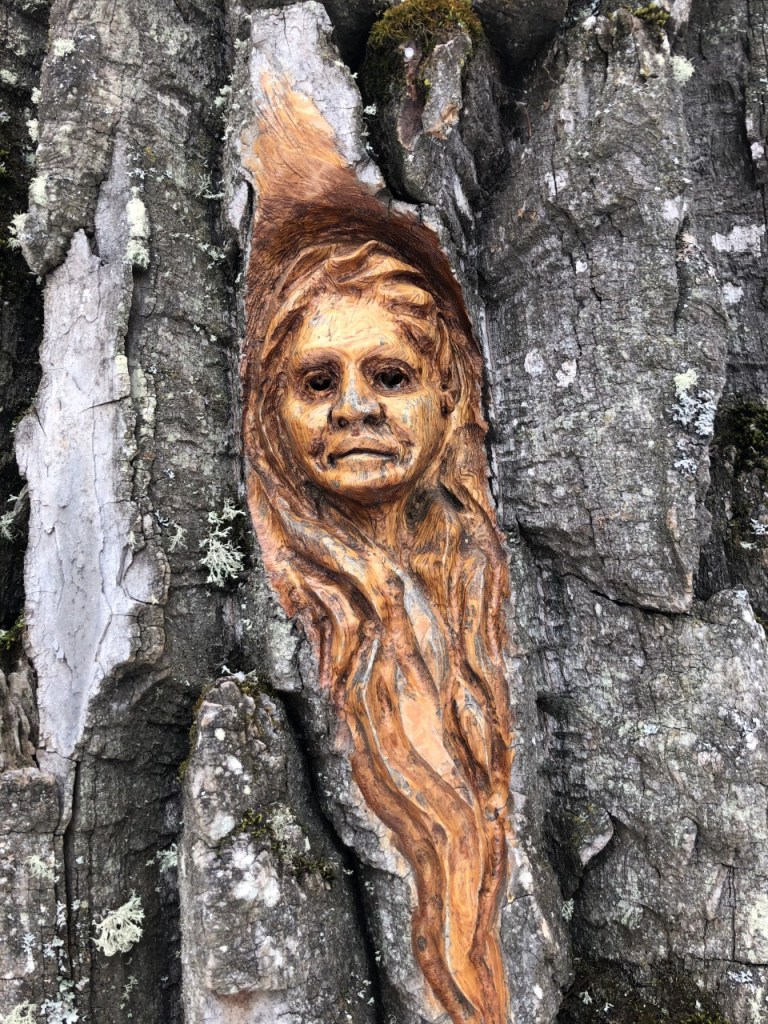
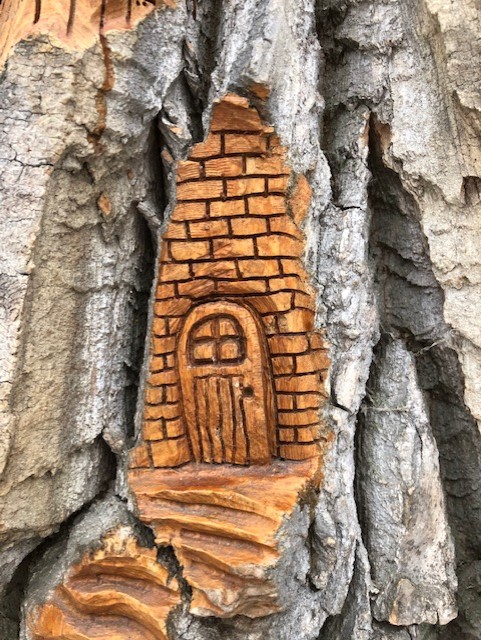
But it is the stunning tree carvings which make this island park an attraction. Carved directly into the trees by local artist Elmer Gundersonare are faces, houses and a dragon. Many of them honour First Nation peoples in respect of the fact that the park is on the Lheidli T’enneh territory. It is a magical place which makes grown adults into small children, as each time you spot a carving you cannot help running up to look at it more closely.

Where to start the day
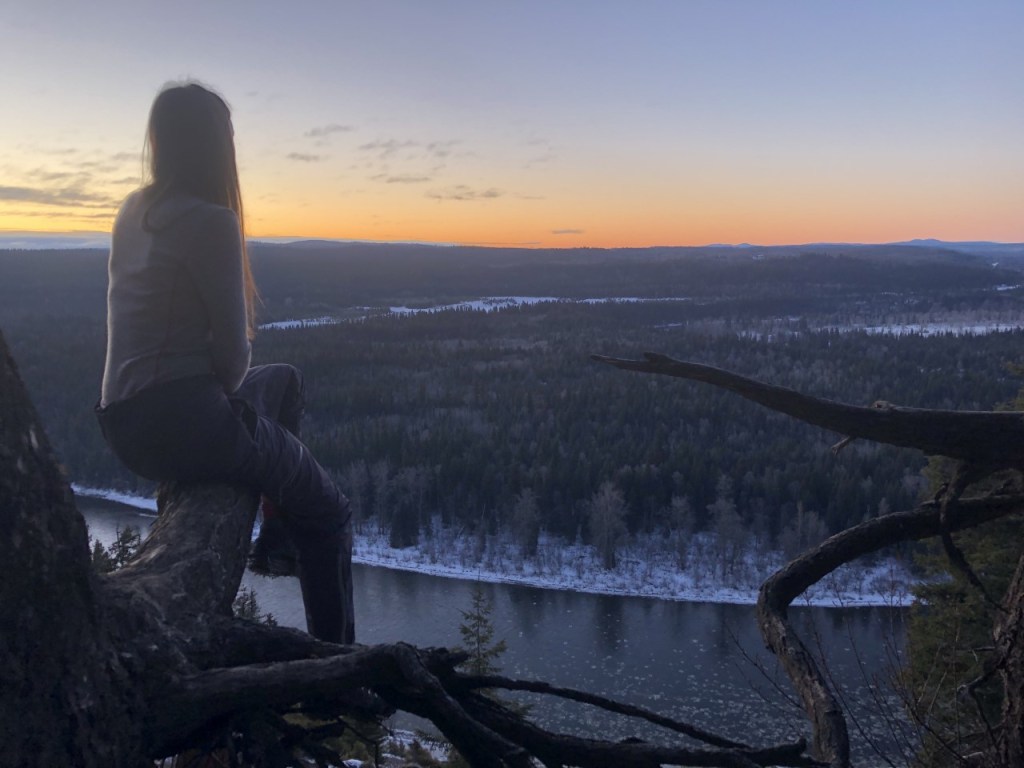
In a post I shared a few weeks ago I described our encounter with Bald Eagles on the North Nechako cutbacks. But it is the beautiful view of the sunrise which makes locals treasure this short walk. One morning we were particularly lucky with a golden sunrise which filled the sky above the trees with an orange glow.

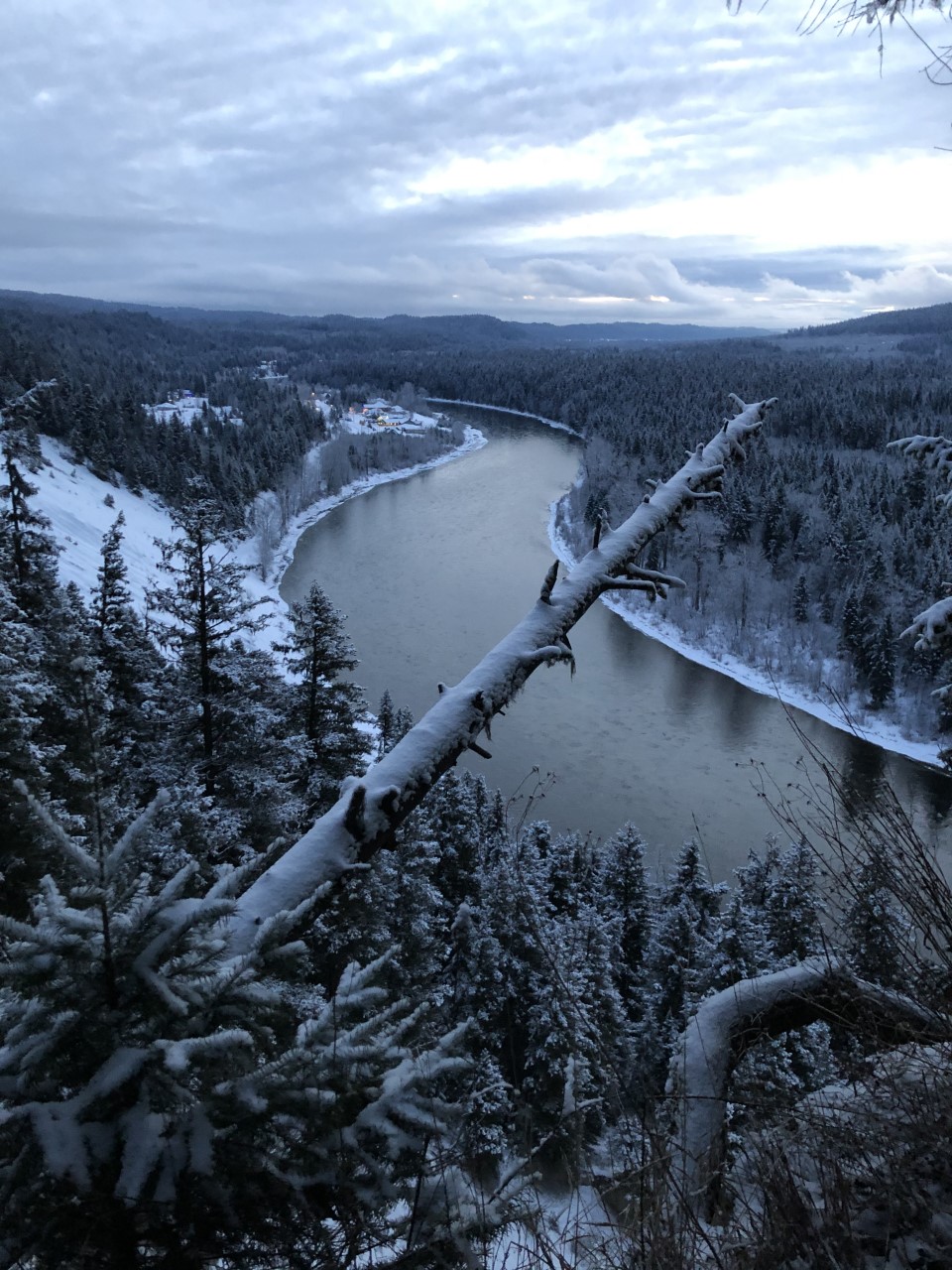
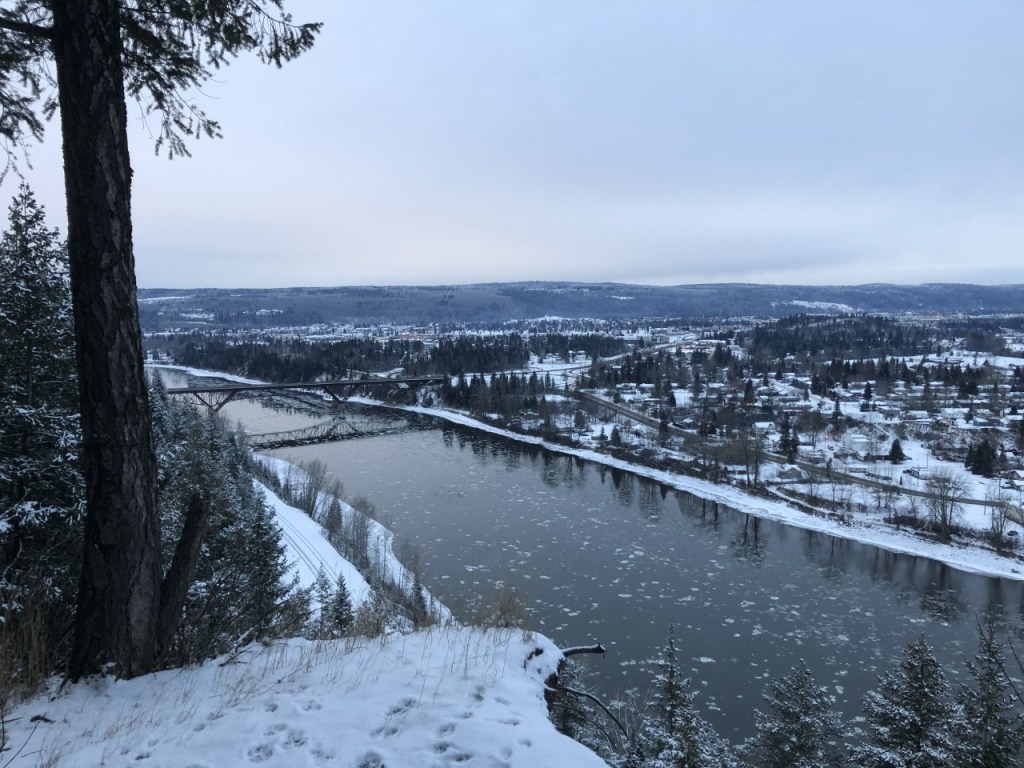
Drag the line to see the view of the Nechako in autumn and winter.

Where to end the day

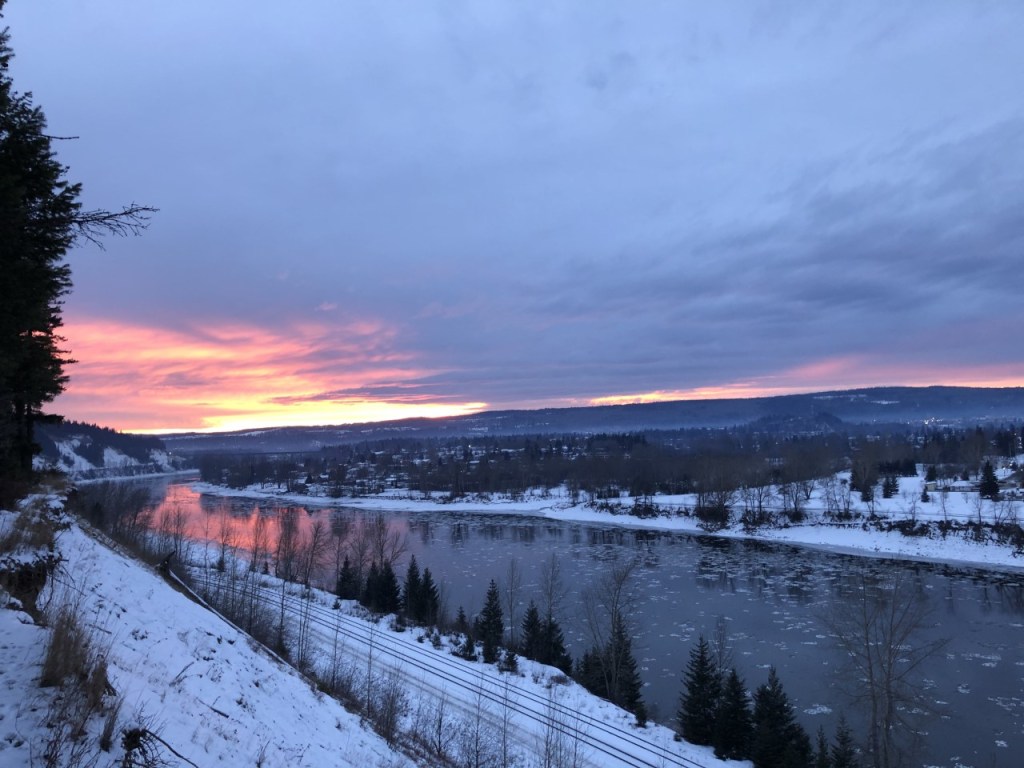
Cloud covered sunset
Final moments of sunset over the Fraser River

The L.C Gunn trail lies just above the city, on a steep bank directly overlooking the river and the railway tracks. After hearing it was the best place in the city to see the sun set, we walked this trail on a few evening but were greeted with a cloudy sky. Finally, after work one Friday, we caught the end of a sunset and our patience was rewarded. The reflection made the river look like it was on fire and, when we stopped to look, we found we were not the only ones admiring the view: there was a Bald Eagle on a branch below us, watching the light fade over Prince George.
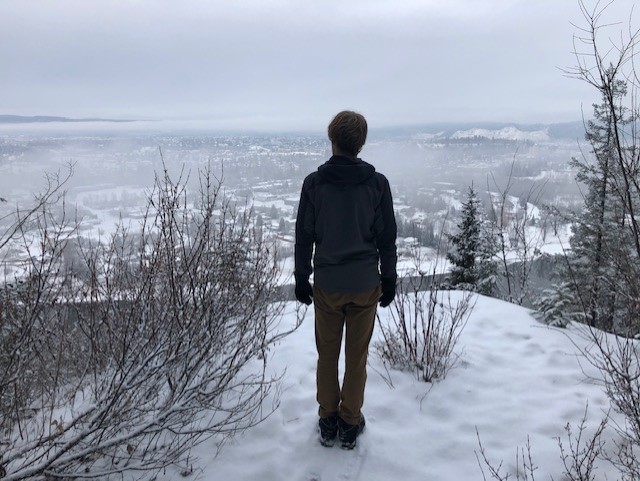
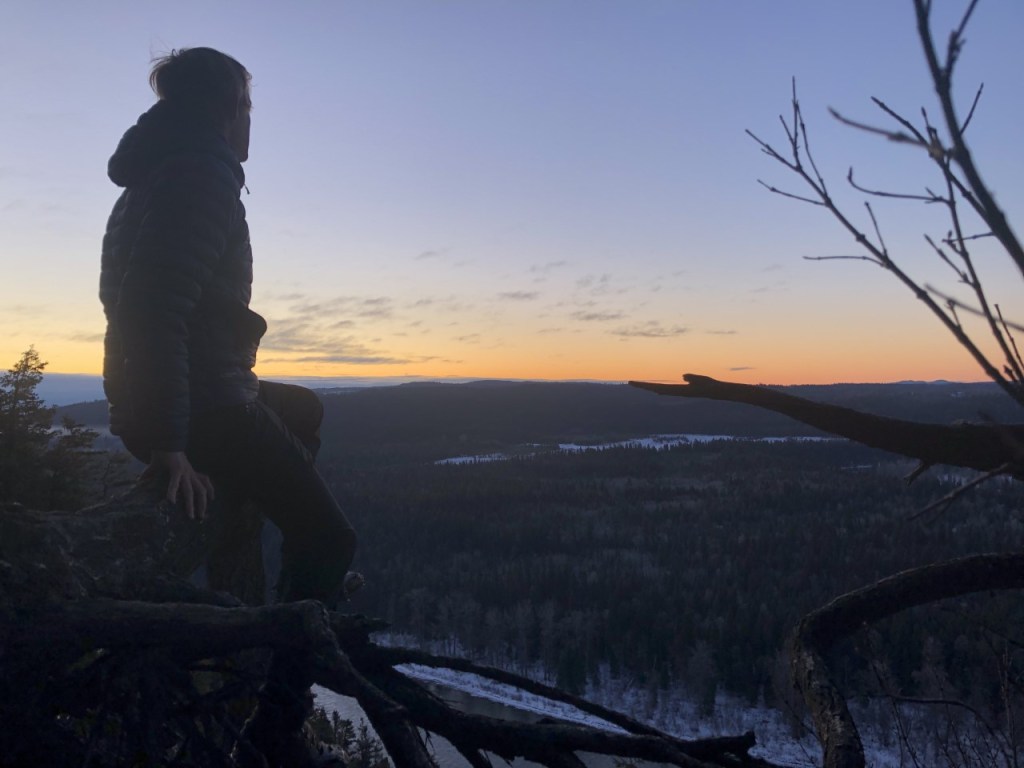
Jacob looking out over Prince George

2. City life

The perfect café

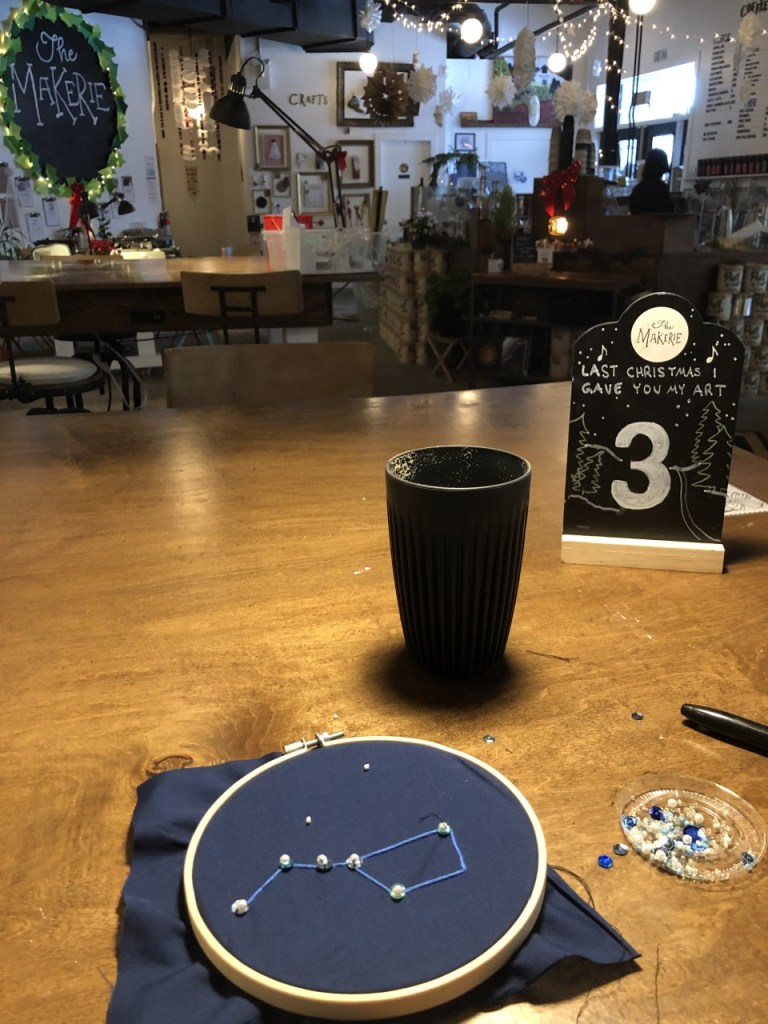
The Makerie has two menus: one for choosing your beverage and one for choosing a craft. There is a craft station where they keep all the supplies, a letter writing station complete with a typewriter and large tables with individual lamps. To be able to sit in an inspirational maker space, order a latte and a cookie AND A CRAFT is without a doubt my idea of café perfection.

A Down town boutique
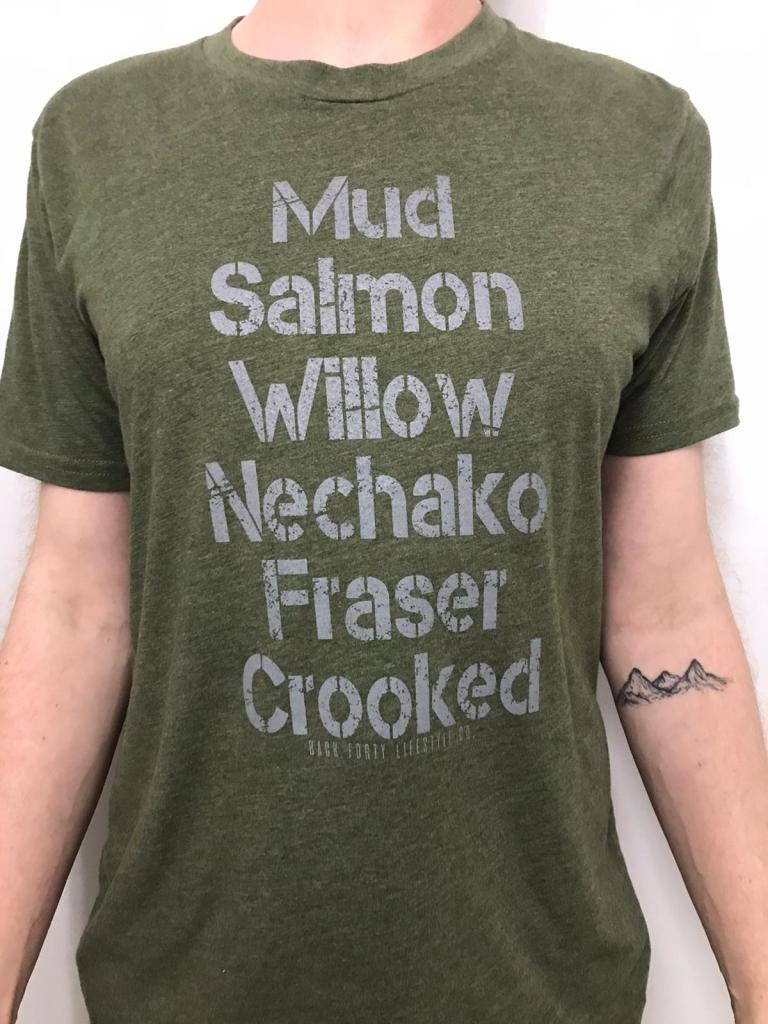
Canadians seem to have a real love of, and talent for, celebrating the great outdoors in their designs. Nowhere is this more evident than among the on-site, screen-printed clothing available at the Back Forty Lifestyle Co’s shop in the downtown. There are many stunning designs with trees, mountains or phases such as ‘live wildly’, but it was the t-shirt with the list of local rivers (can you spot the two I’ve already mentioned in this blog?) that I decided on for Jacob’s Christmas present.

A hidden hipster restaurant
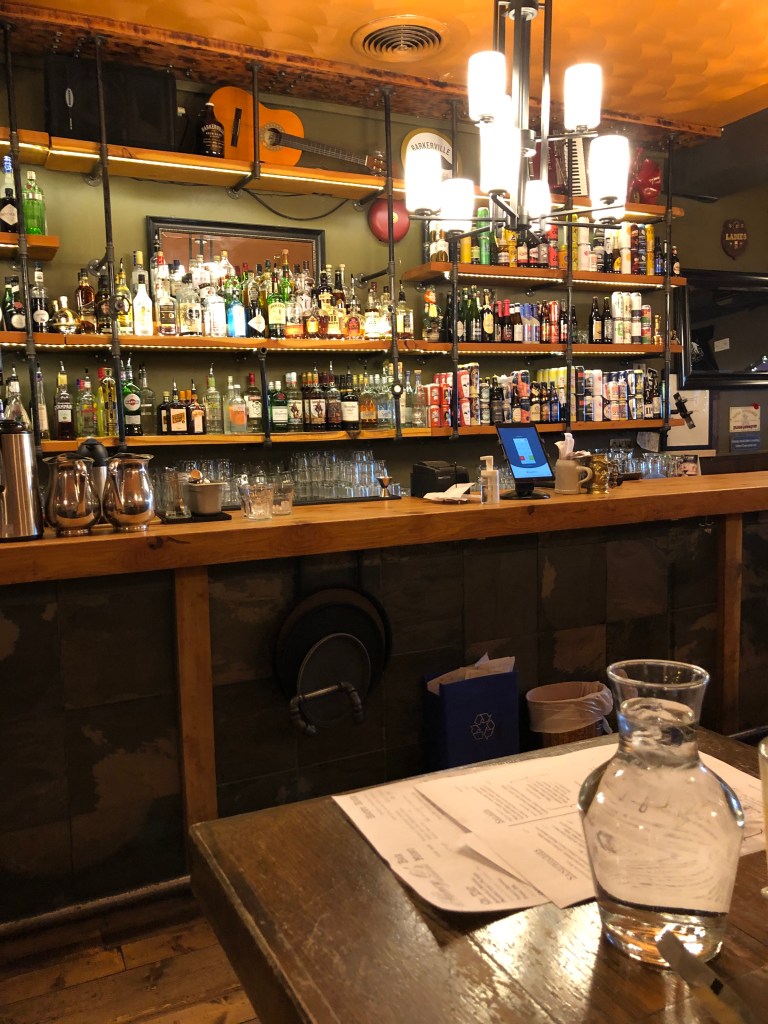
I know what you’re thinking, aren’t all hipster businesses ironically disguised as something else – a cafe in a launderette etc. But trust me, the façade of this place – including a weather-beaten red canopy with ‘Nancy O’s’ written in dated front – gives little indication of what you will find inside. But a peak at the menu online gives you a hint of the vibe though: no restaurant has such good plant based offerings without having a touch of the millennial/hipster spirit we all secretly love. In addition to the cool, lounge vibes they offer a tempting cocktail menu and, unsurprisingly, this is Canada after all, a beer menu so long you’d need more than one lifetime to finish sampling it.

3. Wildlife

Near miss with Mrs Moose

Jacob’s first moose encounter

It took almost four months before I had my first Moose encounter. Jacob had his during the short lived period that he was here without me before Covid hit. It was a cold, clear night in December when I saw my first moose. The Northern Lights had been seen the night before and so we decided to drive out of the city to a dark spot encase the spectacle made a return. We drove north on the highway, further and further away from the city lights and into the darkness when suddenly a large animal ran out in front of our car. It was a female moose who gave use a disgusted look before trotting away. Thankfully, moose, humans and car all came away unharmed. We kept our eyes peeled as we drove back, discussing how the Northern Lights might have eluded us but at least we had seen a moose. Not far outside the city a spectacular, fully-grown male moose was grazing on the side of the road. We slowed down, marveling at his gigantic antlers and unfathomable stature.

4. The weather
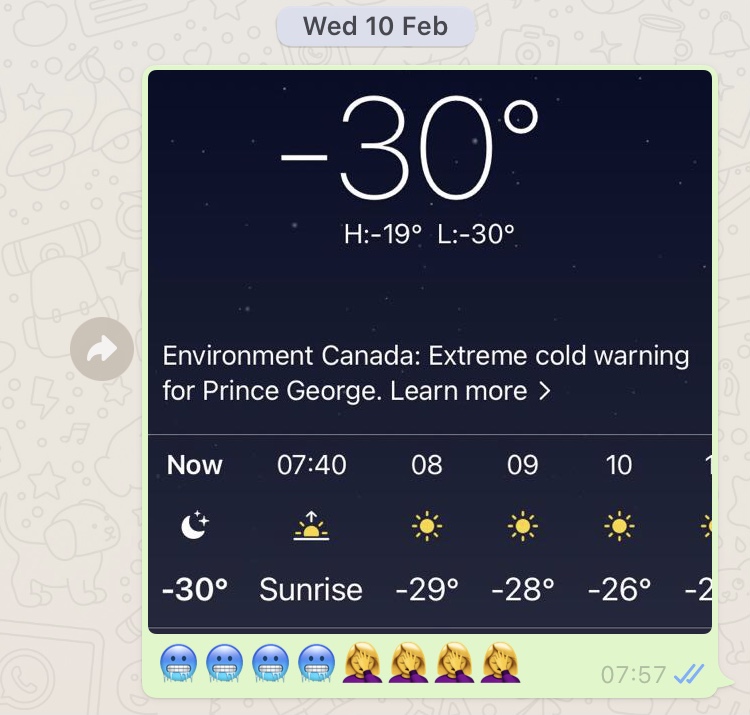
The emojis say it all.

It would be remiss of me not to comment on the element of life in Prince George that I was most worried about: the cold. Turns out that the ‘dry cold’ here is very bearable. On a -15C day here when the sun shines and the snow glistens I moan far less than I did on a +3C day in the UK when the wind drives the rain into your face and clouds have covered the sun for weeks! I’ll be honest, the week we endured -30C was a different matter. But, it only lasted a week and I came out the other side with all my fingers.

5. The perfect Prince George afternoon

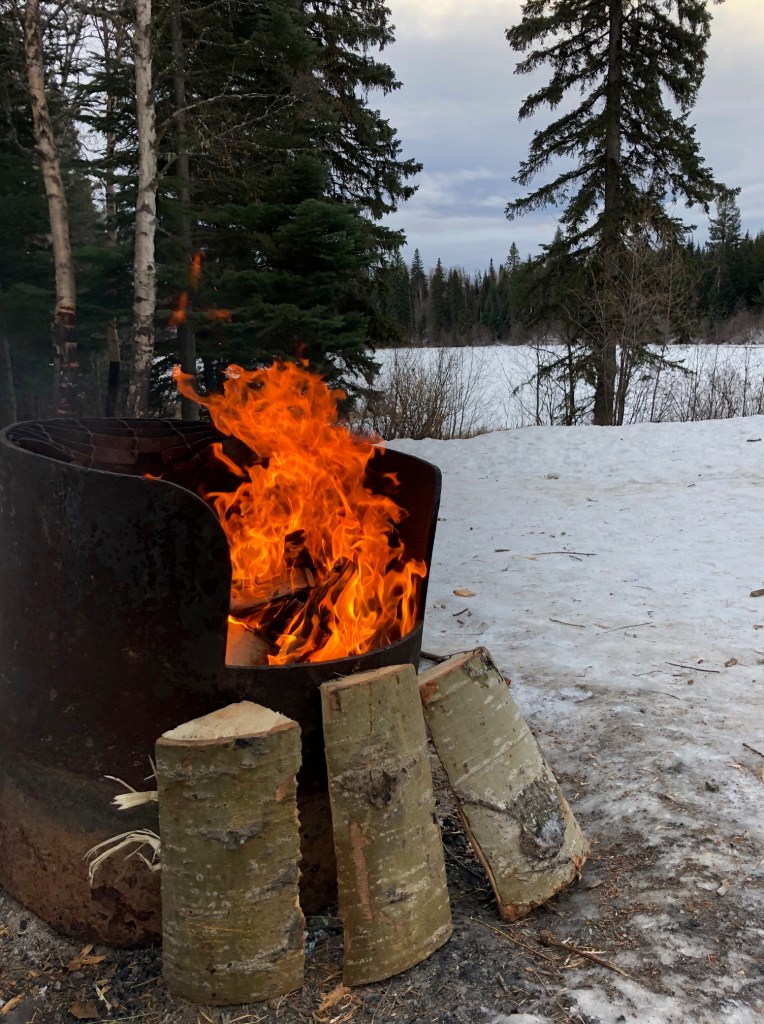
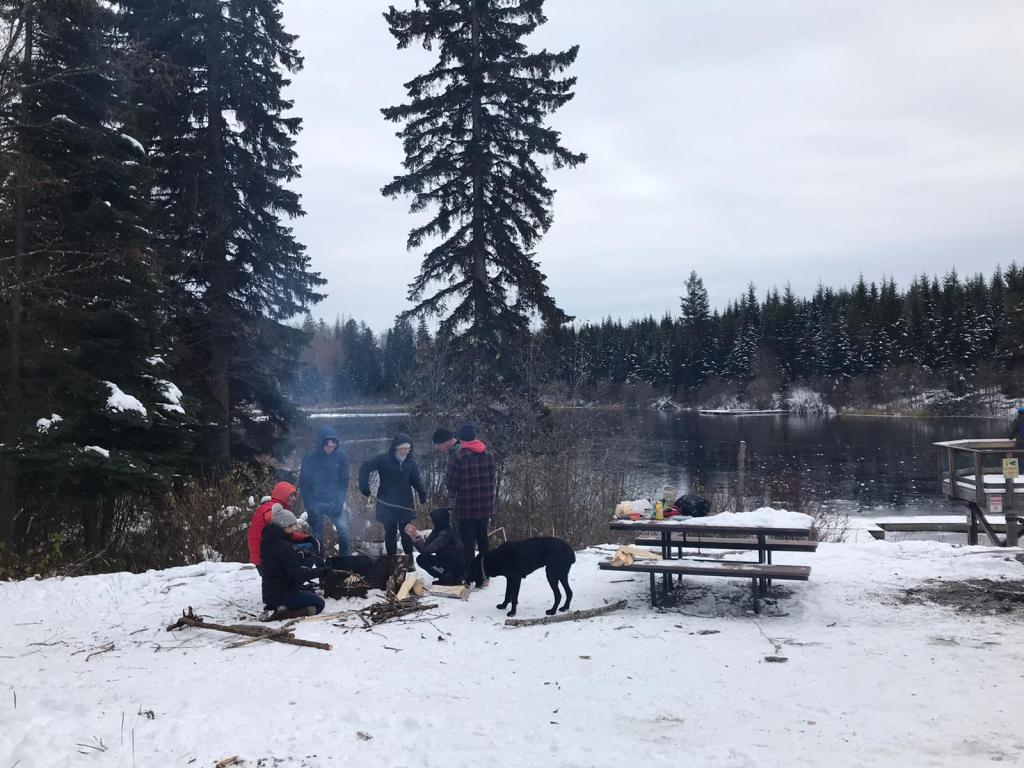
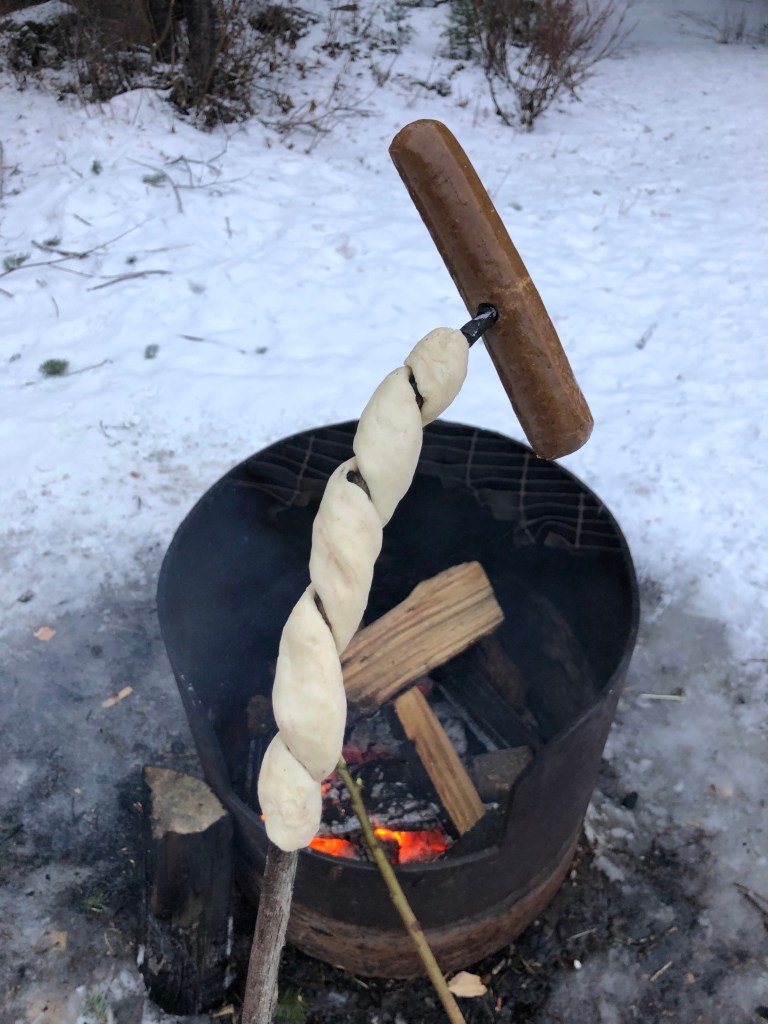
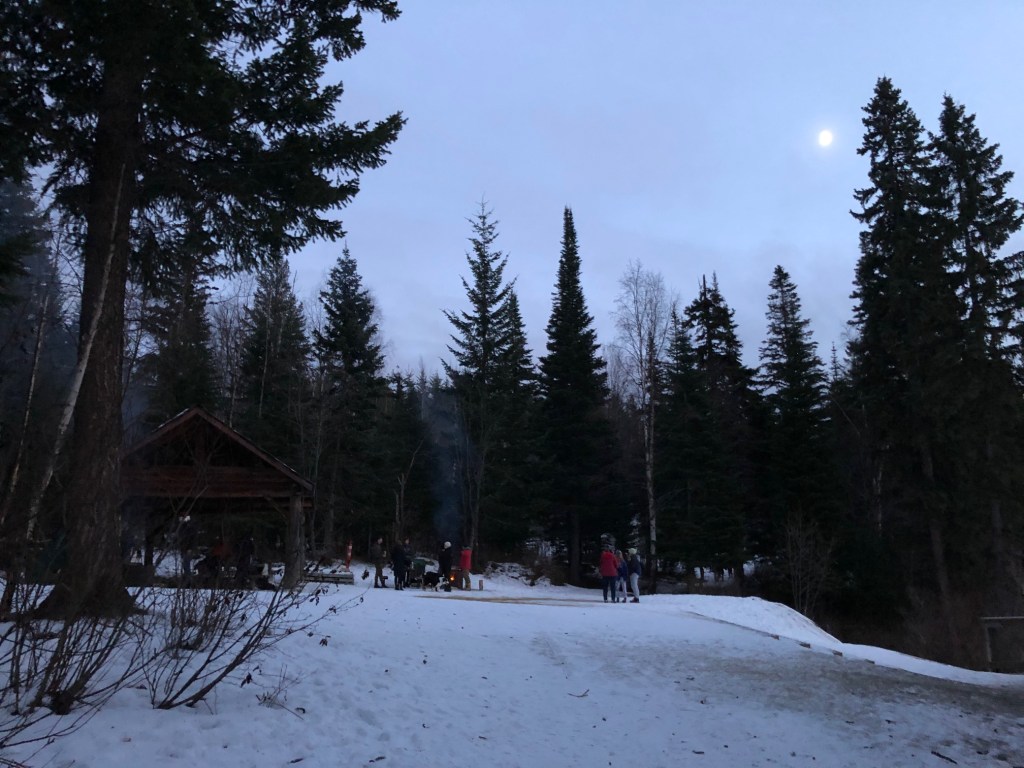
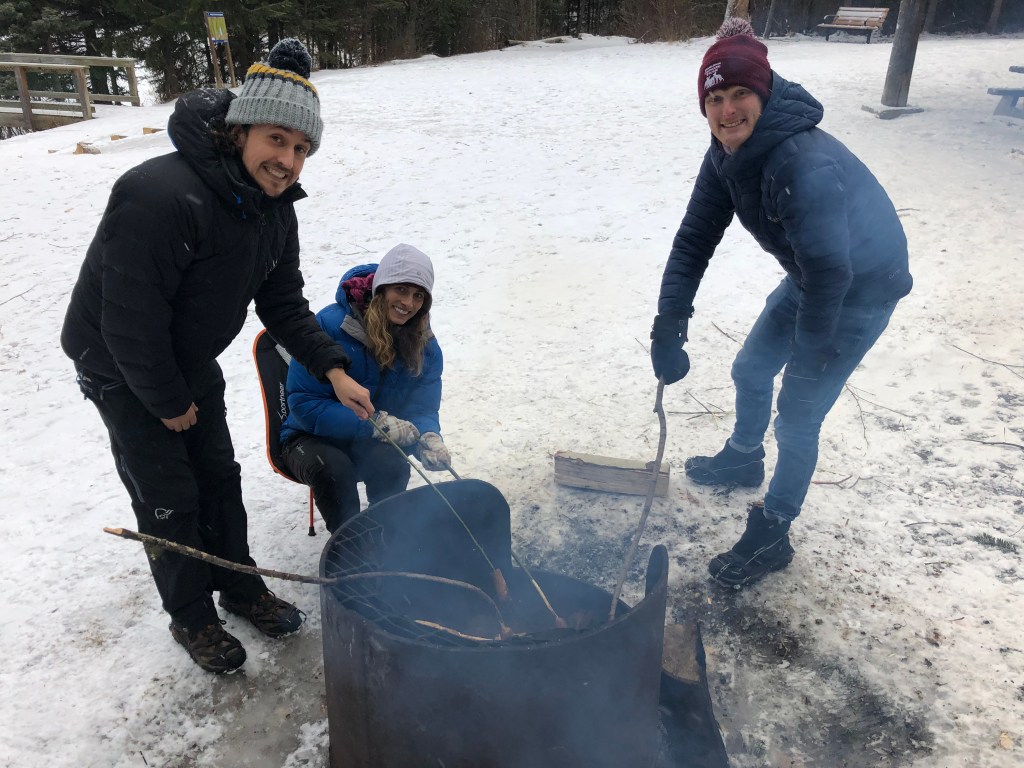
I remember the very first time we had a fire pit at Shane lake on a Saturday afternoon, I was buzzing for days afterwards. Totally in awe of the fact that just a five minute drive from our house was a spectacular ice-covered lake where we could have a fire using a pit and wood supplied by the city, next to a large communal shelter in a magnificent forest. We have returned to do the same so many times I’ve lost count. Each time we cook PB hot dogs over the fire on sticks we’ve gathered and whittled, we laugh as someone loses a marshmallow and everyone drives in with sticks to rescue it and drink beers that have begun turning to slushies from being buried in the snow to keep them cold.

Often the afternoon has more magic than just the fire: on the Winter Solstice binoculars were thrust into our hands by strangers who insisted we saw the conjunction of Saturn and Jupiter and on New Years Eve we shared the space with a First Nation family who were drumming and singing.
. . .

So we’ve established that Prince George definitely is not the armpit of BC. But I am willing to acknowledge that Jacob and I are perhaps particularly well suited to living here. We grew up and went to school in a small, rural English town. If your formative experiences matter most, then Prince George will always feel relatively big to us. We also love being outdoors and have thrown ourselves into experiencing everything the Canadian wilderness has to offer, if you do that, Prince George will reward you endlessly.

No matter whether we are enjoying life here because Prince George is British Columbia’s best kept secret or because Jacob and I fit well with the Prince George lifestyle We feel immensely lucky to have the opportunity to live in this beautiful place with endless opportunities for adventures, great places to eat and always the knowledge that at the end of a weeks work Shane Lake and the fire pit will be waiting.

. . .

Read more about Prince George…

9 things I’m excited about seeing and doing in Canada and Prince George

First impressions of life in Northern BC, Canada, in 3 photos

First Nation, Fur Trade and a Train Station: How Prince George became a city.
Subscribe for email updates…

Moonlight skates and purchasing mistakes: Getting involved in Prince George’s enviable Ice Skating scene

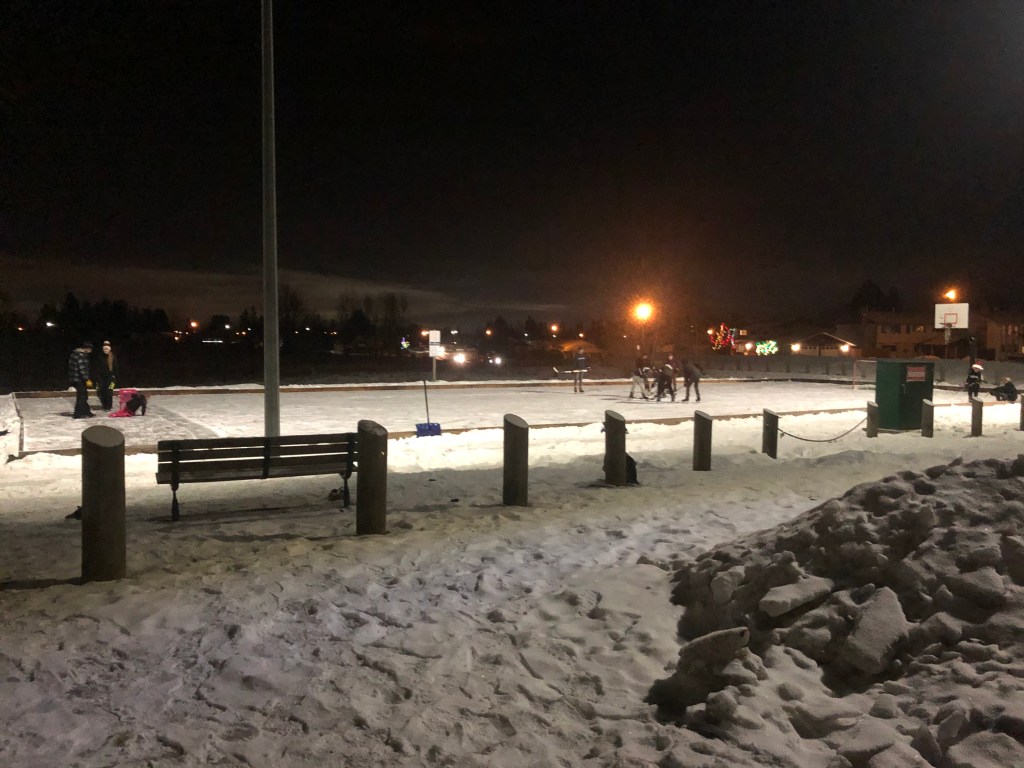
It began on a walk with Bally, our retired racing greyhound, who has very dodgy legs and so he doesn’t join us on our long hikes. Instead we walk the streets of our local neighborhood with him and this resulted in the discovery of a local gem recently: a free ice rink, five minutes walk from our house.

Locals sharing the free ice rink

Our typical evening walk takes us past a kid’s play park and a small basketball court. On one such walk in early December we passed by the basket ball court to see, to our amazement, a father and son practicing ice hockey. I assumed they were taking advantage of an ice rink that the climate had created by accident. We watched them for a while, transfixed by their fluency on the ice. Amazed that they played hockey on ice skates with as much agility as they would on their feet.

My first lonesome skate

The following evening a group of teenagers were there. We once again marveled at their skill as they glided at speed shooting the puck into the air with great force. By the third evening it became clear that this was more than just an accidental ice rink. On this occasion there were three teenage boys playing hockey at one end and, at the other, a toddler learning to skate with the support of a small chair and the encouragement of her parents. The teens were swooping around at a crazy speed. Several times I panicked when one of them appeared to be on a collision course with the toddler. But then suddenly, at the last second, he would rotate his upper body, turn both feet sideways and dig in his back foot to perform a high-speed, dramatic stop, inches from the small child. All the while her parents, who had complete confidence in the boy’s skills, didn’t flinch. 

My bargain/bad decision skates!

Amazingly, this ice rink is just one of 23 that are spread across Prince George. Each one is free, open 24/7 and maintained by a group of local volunteers who are led by a qualified ‘Ice Captain’. Anyone can become an ‘Ice Captain’ by attending the Ice Making workshop which is provided for free by the city to train these volunteers how in flooding techniques for making safe ice. 

My first skate

One trip to the gigantic thrift store later I had a pair of figure skates for $15 (about £9) and was ready to hit the Ice! Unfortunately, Value Village didn’t come up trumps for men’s skates and so Jacob would have to wait for a trip to Canadian Tire to get a pair of new ones.

Jacob’s first skate on a half shoveled rink!

I was chuffed that I had been able to get some skates that fitted me so cheaply. But I should have heeded the words of our Swedish friend (people from cold countries always know best when it comes to these things) who said he’d always fallen over on figure skates because of the toe picks. These are jagged teeth at the very front of the blade, which figure skaters use to perform jumps and spins.

Ice skating together on Christmas Eve

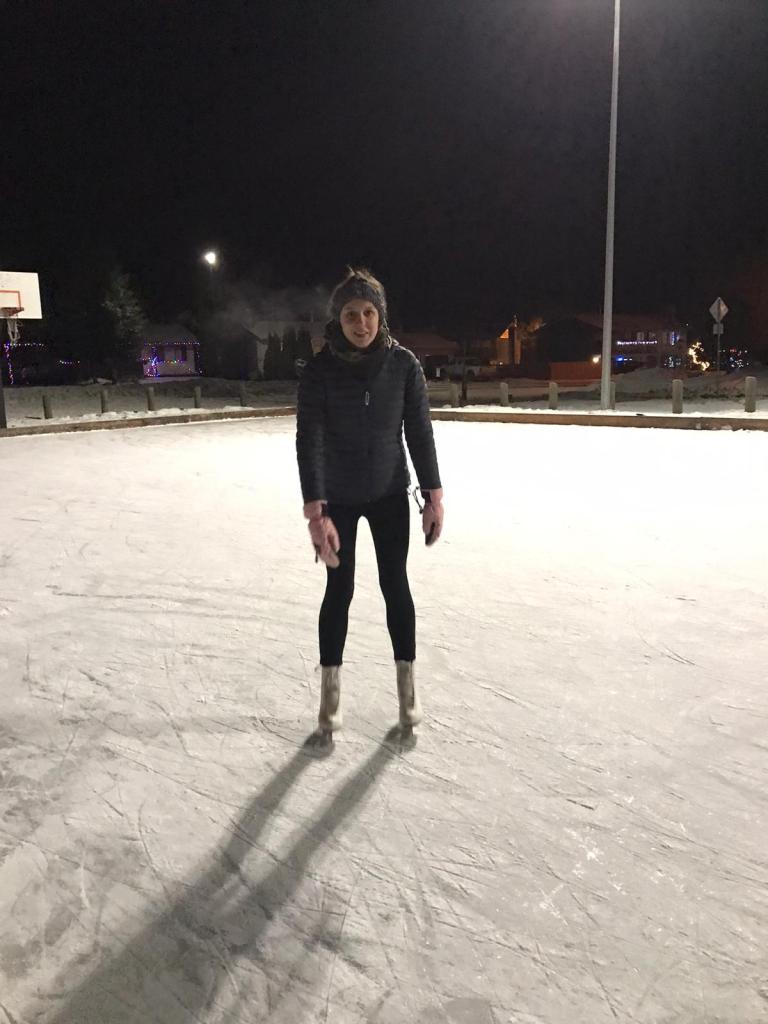
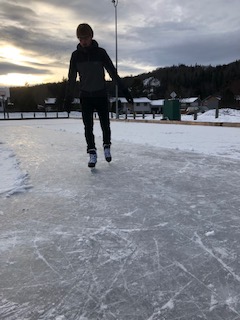
We had to wait all evening to get on the ice for my first skate but eventually the Rink Rats (a term for kids who hog the ice to play hockey) went home. We switched on the flood lights and I tentatively got on the ice. Having never skated on natural, imperfect ice, which has had heavy use by hockey players, I had to get used to avoiding the thinner bits, slashes and holes. Even still, I spent most of that first skate in awe of having a moonlit ice rink all to myself.

Jacob Ice skating on Christmas Eve

The next morning, back pacing the pavements with Bally, we noticed one of the volunteers at the rink shoveling yesterday’s snow fall and repairing holes. He told us all about how they make the ice, when the temperature is around -6.C or colder for three consecutive days, by freezing water repeatedly in layers. They then add new layers of ice throughout the season by flooding the rink again and letting it freeze overnight. He was busy filling in some of the holes created by the ice hockey players. He showed us a technique he was trying out that he had seen officials (referees) use mid-way through hockey games: mix up some snow and water into a slushie, put it in the holes and leave it to freeze.

The Oval Ice Rink

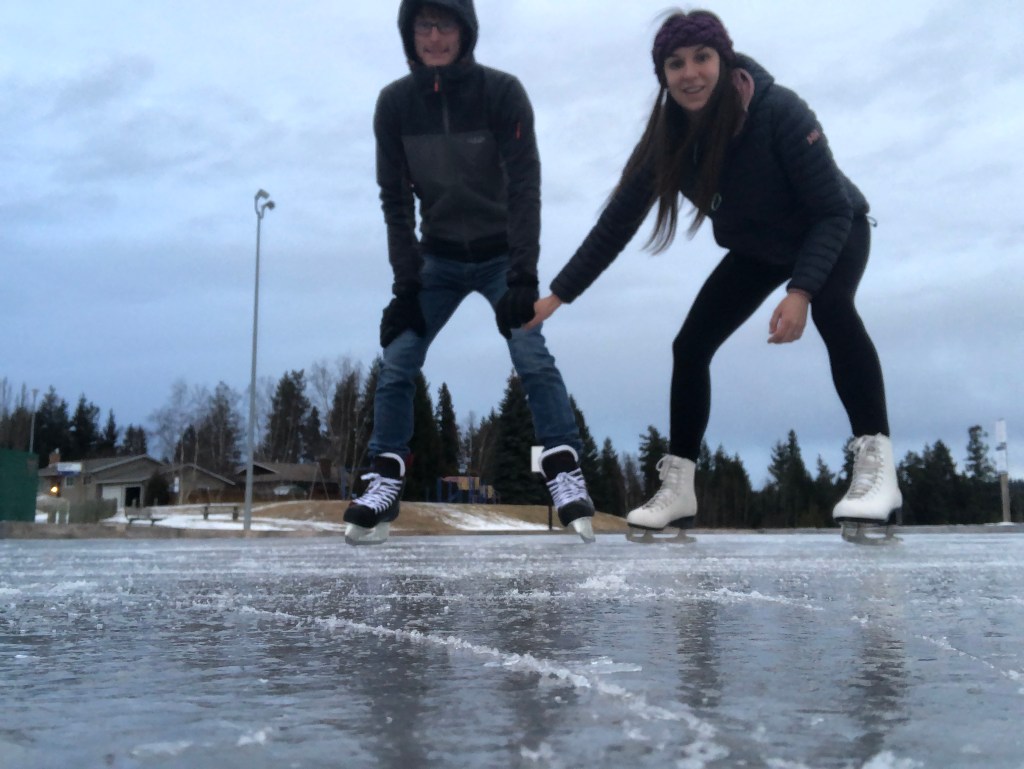
Over the next week Jacob bought ice skates and, after the Rink Rats had vacated, we had the rink all to ourselves in the moonlight several times. Being alone meant we could get faster and test out new skills at our own pace. One evening, when I was starting to get confident, I showed Jacob a technique for stopping I was having a go at. He tried it out, but his blades didn’t move over the ice properly. His leg and knee twisted but his boot stayed still. The result was a swollen knee and the need to work out what was wrong with his brand-new ice skates. 20 minutes on google told him that he should not be using his new skates and that they could even be dangerous, as they had not been sharpened! 

The Oval Ice Rink

Presumably, the people at the shop didn’t think we needed warning about sharpening the blades because this knowledge is so ingrained in the Canadian psyche that they can’t imagine anyone not knowing these things! Sharpening is important because it creates a hollow between the two edges of the blade. As you skate forwards, the ice in this hollow melts which creates a smooth glide. Most people also get their new ice skates baked, this molds them to your feet and creates a better fit.

The Oval Ice Rink

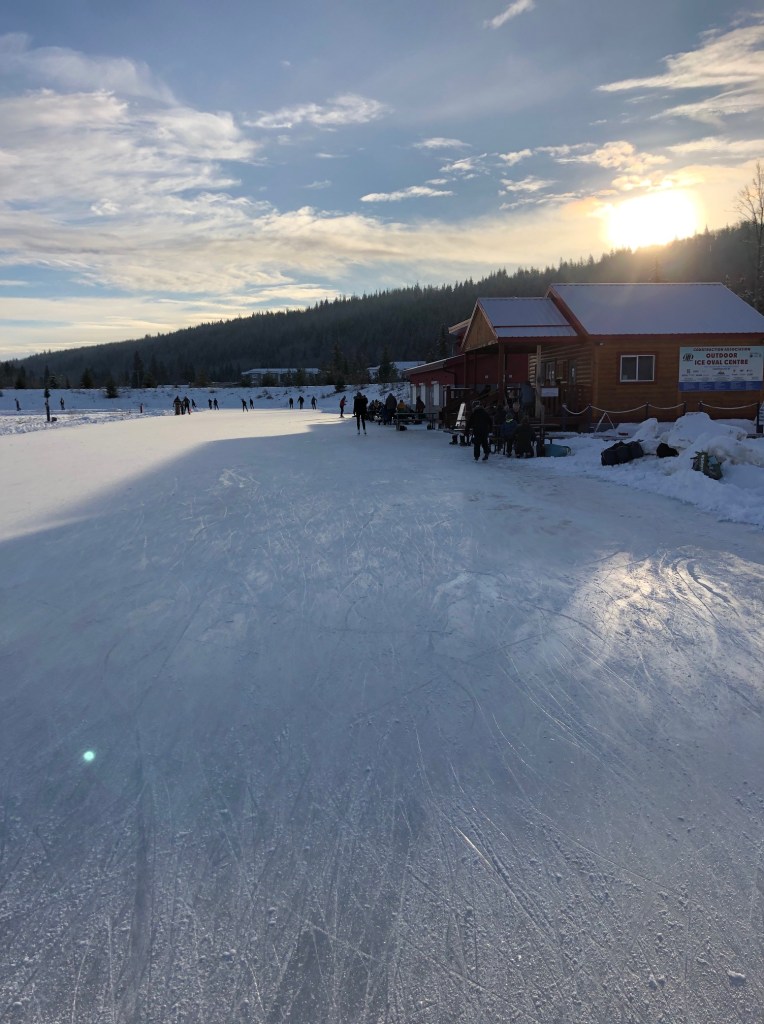
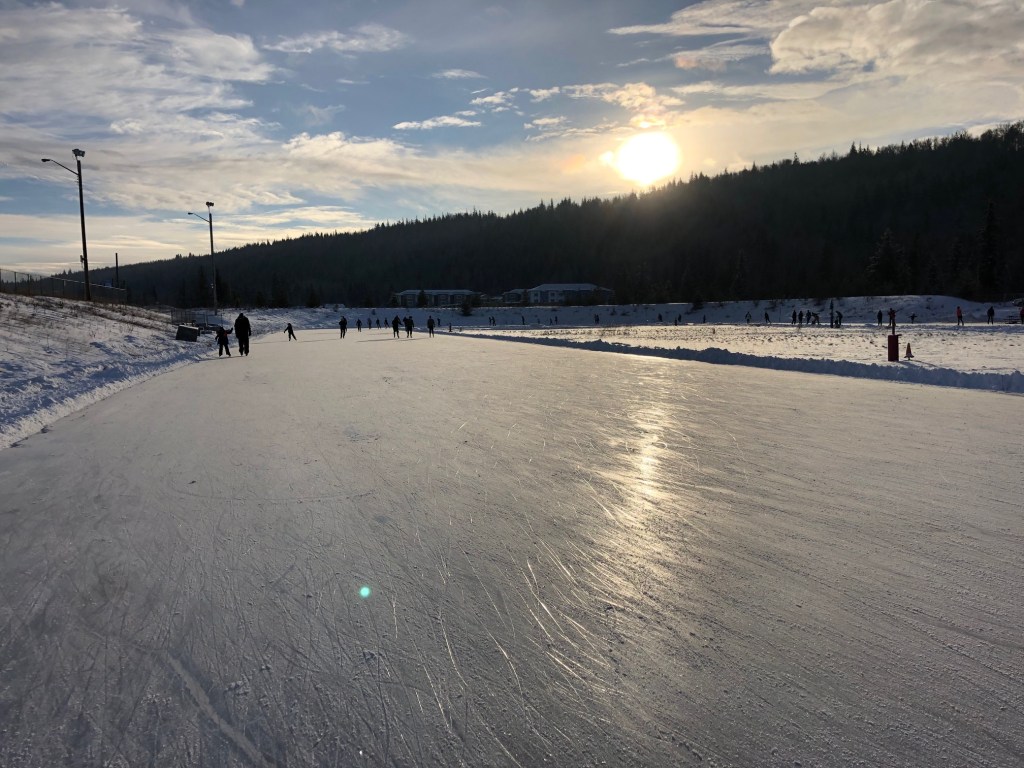
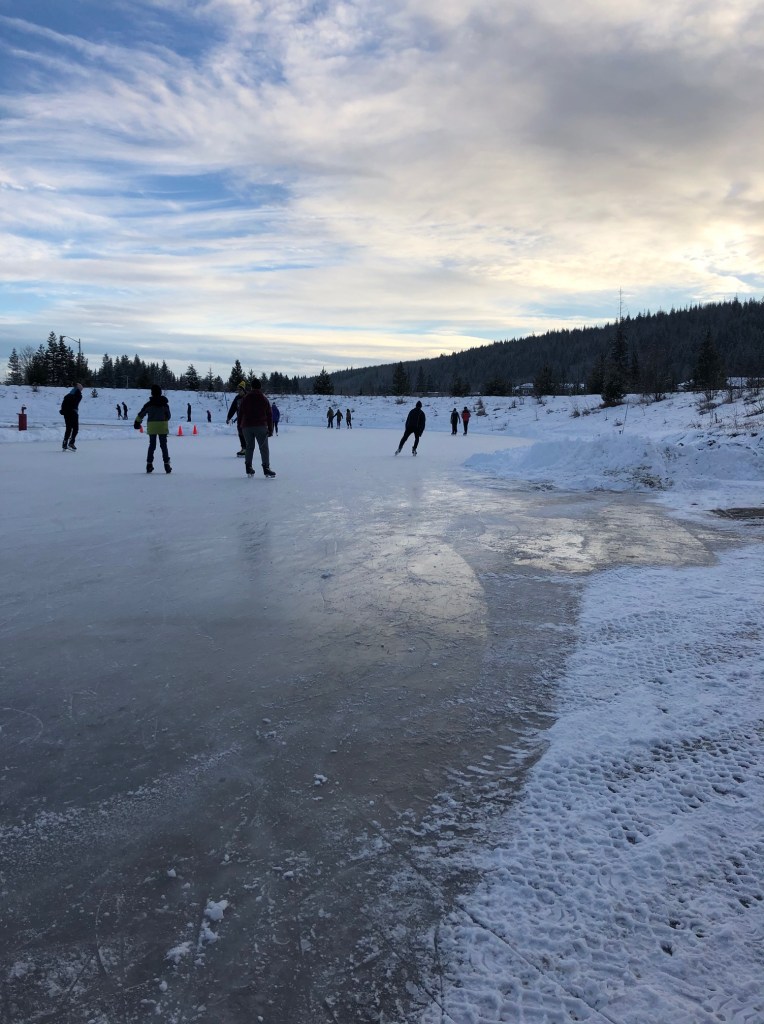
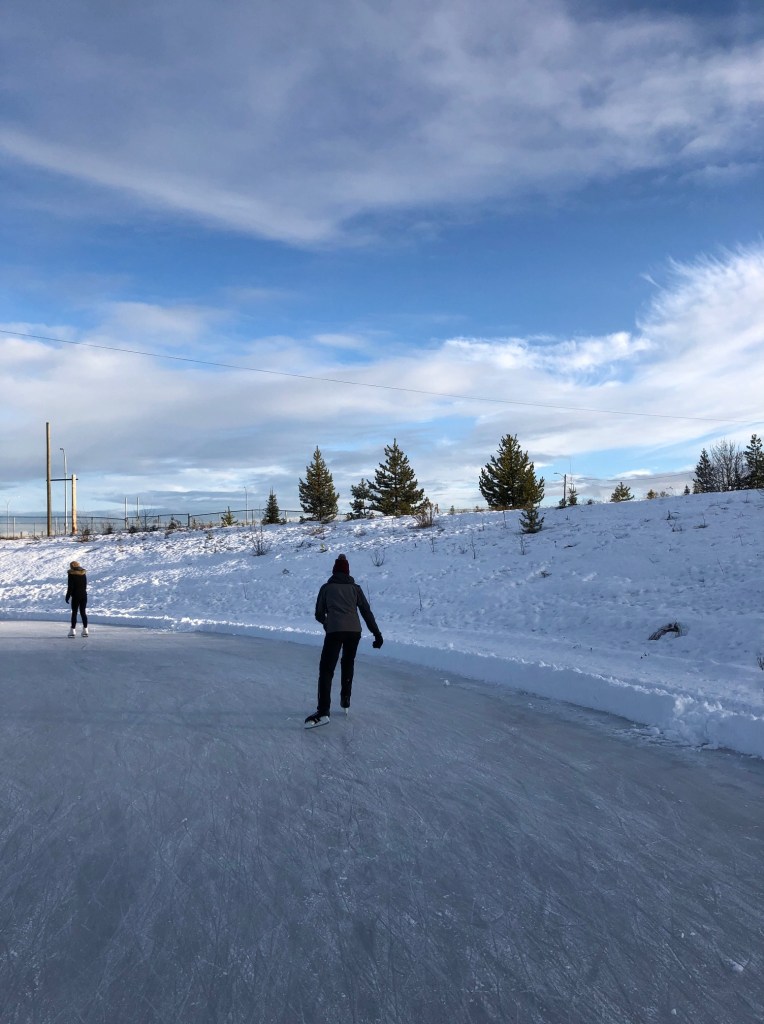
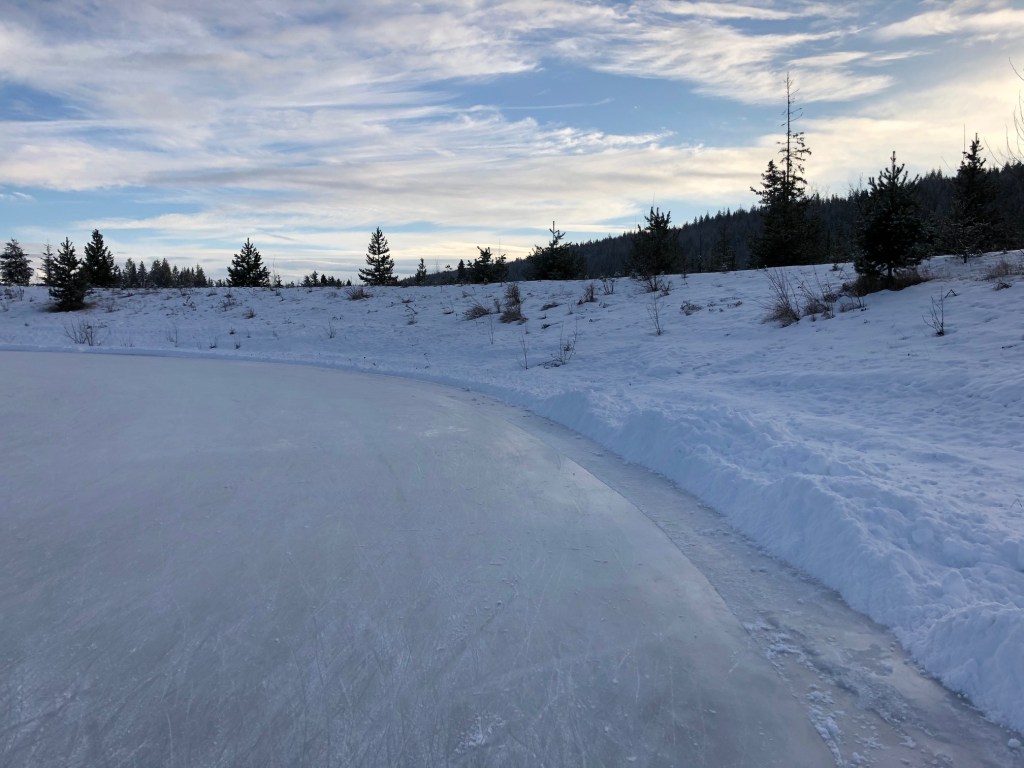
Amazingly, Prince George’s outdoor ice rink facilities don’t end with the 23, free, community-maintained rinks. There is also The Oval, a 400-metre track made from natural ice and, again, maintained by a team of dedicated volunteers.

On our first trip to The Oval the sun was shining, the sky was blue, and the ice was perfect. One side of The Oval is lined with Evergreen trees and the outlines of them shone in the afternoon sun which was setting behind them.

The Oval Ice Rink

We had been worried that we would be to slow for the pace, but there were lots of people there who were learning and so we were far from the worst. Still, you must watch out for the little kids whose style of skating is to sprint as fast as they can, fall down, get back up and then wizz off again. A distinctive clicking comes from the people wearing the long-blade speed skates who whoosh by, not going as fast as you know they can, but, still leaving you in their wake. The obvious hockey players weave along backwards talking to friends. But my favorite was the sight of one couple who obviously couldn’t decide who should go on the ice and who should look after their baby, and so they brought the pram onto the ice and skated along pushing it. 

The Oval Ice Rink

Jacob and I were taking a lap together talking about how beautiful The Oval was and what an awesome thing it was to have a five minute drive from our house when the toe pick on my boot caught in the ice and I came to a sudden, crashing stop. My wrist, shoulder and head all smacked the ice at speed. I’d been warned that the toe pick might be a problem for a learner and now I been forced, with a very sore head, to concede to that fact!

We’ve learned a lot about the creation and maintenance of natural ice rinks, skating culture and how to – or how not to – buy ice skating boots! We’ve also both had our first nasty accidents, Jacob discovered the importance of boot sharpening and I’m going to buy a new pair of skates that are NOT for figure skating! Prince George has the most incredible ice skating facilities and once Jacob’s knee and my shoulder recover, we’ll be back on the ice. After all, we have yet to try the ultimate Canadian ice skating experience that Prince George has to offer…

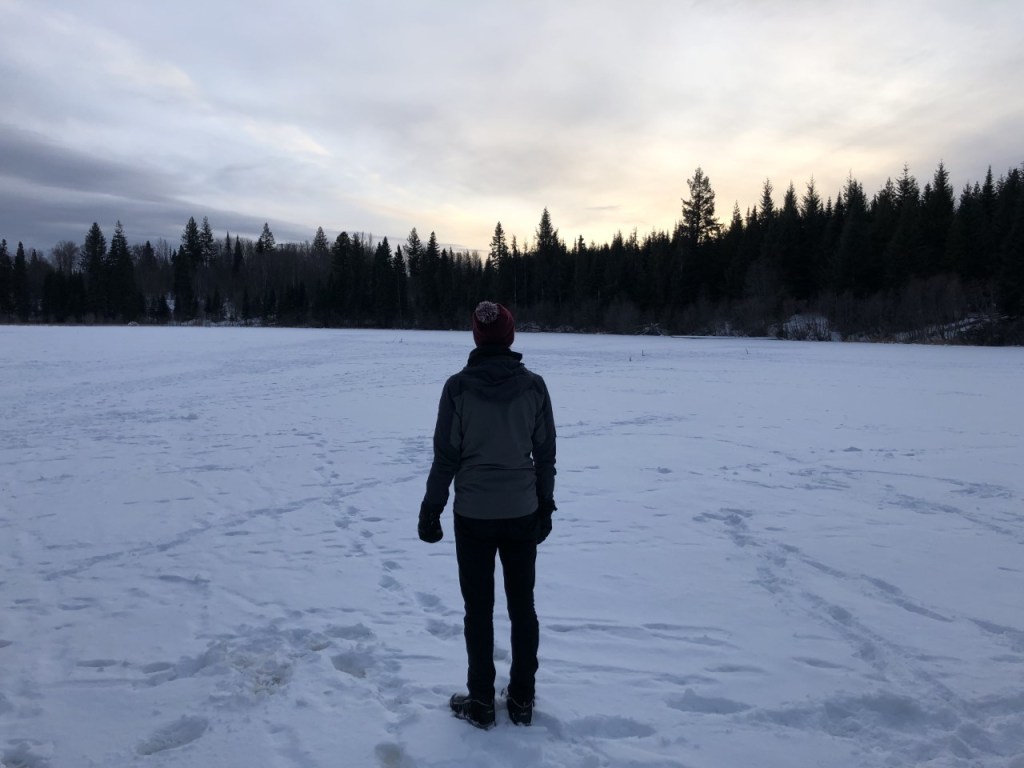
Jacob walking on a frozen lake.
The location for our next ice skate?

A guide to surviving as a British Secondary School Teacher in Canadian Elementary Schools

This totally useless (but hopefully amusing) guide covers everything you really don’t need to know about how to survive as a substitute teacher in Canadian elementary schools, if all your prior experience is in a British secondary school teaching History. In this guide I’ll share some highlights and some things I’ve learned – from which words to avoid saying, to the laws of the snowy playground – during my first term teaching in British Columbia, Canada. These experiences reveal some of the language and cultural differences between Southern England and Northern British Columbia, Canada.

There are 8 secondary schools in Prince George and 31 elementary schools, so due to the nature of probability I have not been sent to a single Secondary School to cover absent teachers during my first term here. Thankfully, I have had lots of work in the elementary schools and it has been a fascinating experience.

Things are going to be a little different next term – read on for more about that exciting news in a moment – so I thought now was a good time to share a few of my experiences with you in the form of a guide covering language, clothing, playtime rules and culture.

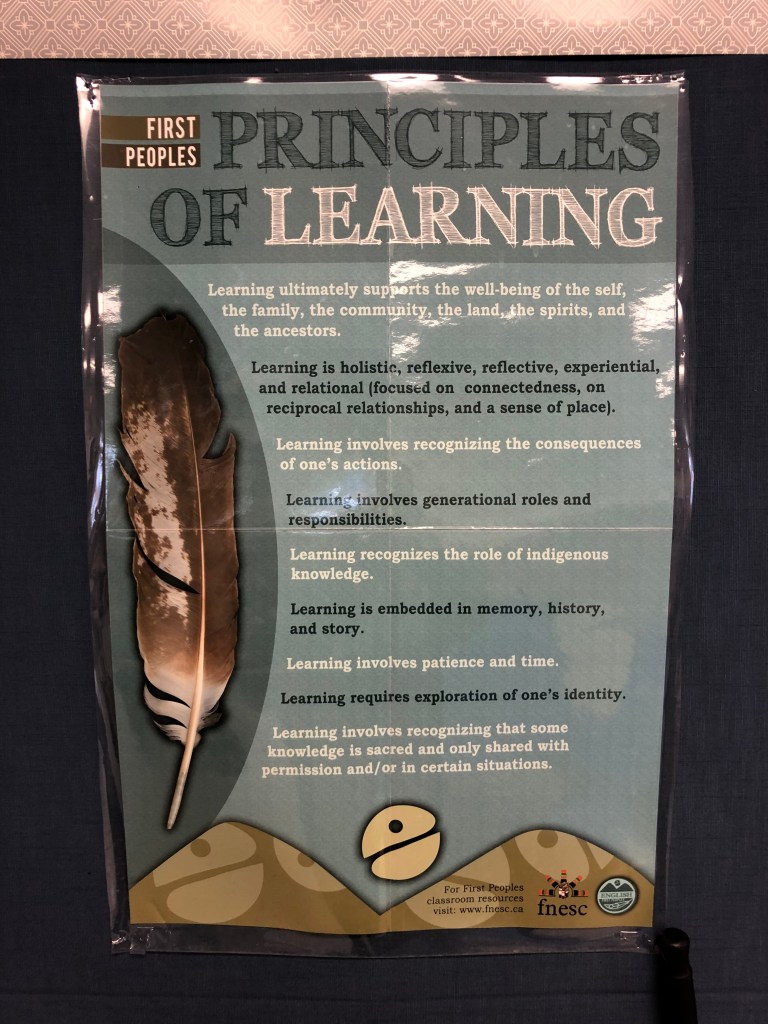
First Nation Principles of Learning Poster

Language

First things first, as a traveller from distant lands you’re going to need to address that ‘BBC accent’ unless you want to have kids asking: “ do you speak Spanish?” and even “What world are you from?”. These are both questions I have genuinely been asked. But my personal favorite was overhearing one worried child ask the Teaching Assistant “What’s wrong with her, can’t she speak English?”

Once you’re over the shock that a pupil could think that you can’t speak English, you’re going to need to work on your vocabulary. If you think it will be easy because there is no language barrier, then use the word ‘toilet’ in front of 30 Canadian kids and you’ll see. Try ‘washroom’ instead, it induces less giggles.

Some words are just slight tweaks which you may assume will be fine, such as the difference between maths and math and sledge and sled. And it is fine, if you want fifteen seven years olds putting their hands up to inform you that you are saying the word wrong for Math.

You may not like it, but the quickest and easiest thing to do is to adopt a whole new vocabulary for when you’re in school. Here are a few words to get you started: recess instead of playtime, swap hat for tuque, replace bin with garbage and try gym rather than P.E. Be warned it’s not just the pupils who will give you a blank stare if you use the wrong word. I once completely failed to get the information I needed from another teacher because I kept asking where I needed to be ‘on duty’ rather than ‘on supervision’.

Sometimes its not what you say, but how you say it that is going to cause problems. Taking the attendance (note another word substitution there: ‘attendance’, not the ‘register’) in one school I called ‘Lawson’ and the child insisted I had not said his name right. Thinking it was not exactly a difficult name and perhaps he just had not heard me correctly, I said it again. Nope, he was still not happy. I tried again, this time imitating a Canadian accent by making the ‘la’ long and sort of dropping the ‘w’ a bit, rather than pronouncing ‘law’ fully. Finally, he was satisfied!

The school PAT/Therapy dog running in for a treat at one elementary school

Clothing

The first big difference regarding attire that you are going to notice is that the pupils are wearing their own clothes. You are unlikely to notice anything remarkable about the impact this has on behaviour etc with the younger pupils. It’s not until humans get a little older that they start expressing themselves through their clothes. That said, hats (tuque) may be a stumbling point. Don’t assume that they are expected to take them off during lessons. I certainly did during my first few days, only to learn that many teachers allow baseball caps in the classroom and by asking them to remove them I was picking battles I could not win.

As an elementary teacher you will need outdoor and indoor shoes. You will need a warm coat, gloves and a hat (tuque). Don’t be a fool and think playtime (recess) is short I’ll manage. You won’t. You will be standing in deep snow while the kids play, you will need snow boots and warm socks. But please note: once inside you will be warm, very warm and so you’ll need summer shoes. No, a decent pair of boots will not cover both, are you joking? With all this layering up and stripping off you better end Maths (Math) ten minutes early. It takes time, lots of time for the little ones to get ready. On the bright side because they are already in comfy clothing they don’t get changed for P.E (gym), so that is much faster.

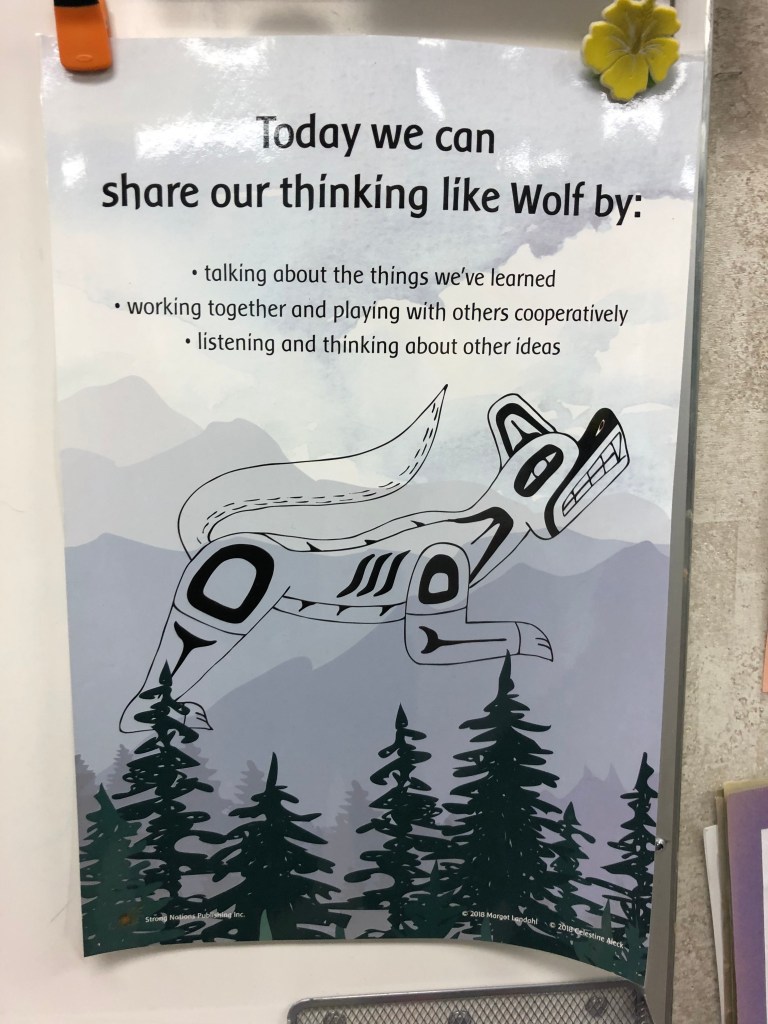
The Wolf: Part of the Seven Grandfather Teachings

Playtime Rules

As a secondary school teacher, if no one is punching each other and no one is smoking, you have done your job on duty (supervision). In the elementary schools here (and I’m sure it is the same in British primary schools) you need to be a little more aware of the nuance of the playground rules. But what is different in Canadian elementary schools to British primary schools is the laws around snow. The pupils are going to go outside in temperatures that would close schools in the U.K, so you better be ready to be the judge and jury of the playground in these tough conditions. Here are a few pointers to help you out as you stand in the freezing cold, watching kids hurtle themselves down snow piles.

1. If you didn’t build the snowman/snow structure don’t destroy it. This rule is universally in place across all the schools I’ve been in and stops squabbles over who destroyed whose snowman.

2. No going on the snow piles without snow pants. In one school I was in, the playground was dotted with giant piles of snow which had been left there after the pathways had been cleared. For some reason rather than ban pupils from these ice mountains, they were allowed to climb all over them on mass. Each snow pile was crawling in multiple pupils fighting their way to the top, at which point they would throw themselves down its steepest, most slippery side. But only if they were wearing snow pants, that known protector from a broken arm!

3. Careful on the ice. Seriously. Not don’t go on the ice, just be careful. Naturally this lead to an entire playtime (recess) spent with my heart in my mouth watching kids face plant.

4. Keep out of the forest in high winds. At a couple of the schools on the outskirts of the city the playgrounds are partially forested. At playtime (recess) the pupils (who are taught what to do if a bear appears in the summer months) have free reign to run wild amongst the trees. I was in one such school on a windy day, after a large snow dump and the pupils were told to keep out of the forest encase the wind blew a large amount of snow out of the trees and on to their heads!

5. Only school sledges to be used at recess, you can’t bring your own. I noticed a stack of colourful, large sheets of plastic hanging by the door in one school and discovered that they were sledges (sleds) for the kids to use. I thought this was amazing, but one boy spent ten minutes moaning to me about the fact that they were not allowed to bring in their own sledges (sleds) from home.

6. Sliding hill is for sliding, not sledging. Quite a few of the schools I’ve been to have hills in their playgrounds and so they have the perfect natural slide for winter fun. With the snow packed down from usage they run, jump and fly down these smooth, ice slides. They look like deathtraps to me, but apparently so long as they only slide and don’t sledge (sled) down them they are following the school rules!

Culture

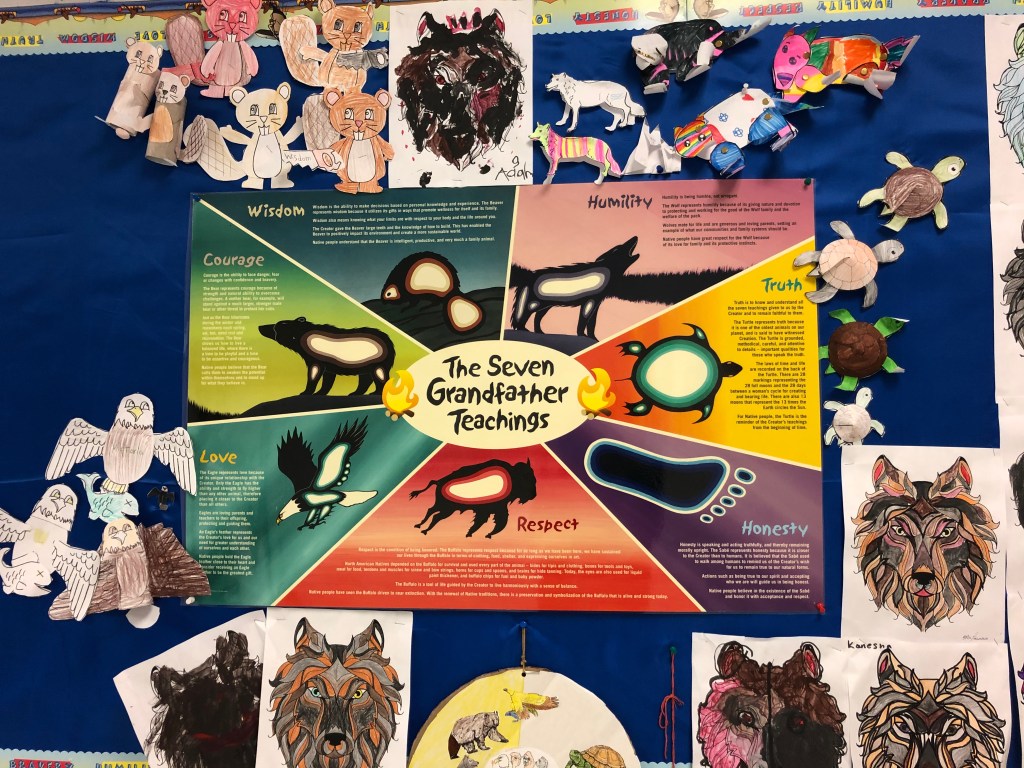
One of the most unique things about being a substitute teacher here in Prince George is the opportunity to experience the local First Nation culture. You will learn a great deal from the First Nation pupils you meet every day (25% of the students here are FN), the Indigenous Education Team in each school and, if you are lucky, the Elders who come in to run workshops while you are there. People pay a lot of money to have a ‘genuine’ First Nation tourist experience, but by teaching here you will learn bits of the Dakelh language and the Seven Grandfather Teachings as they are weaved into every school day. If you are sent to cover a teacher at Nusdeh Yoh Elementry School (meaning House of the Future), the First Nation choice school, your day will begin with drumming rather than a school bell and you’ll sing entire songs with the class in the Dakelh language.

A display about the Seven Grandfather Teachings

The cultural experiences won’t end there, each kid here will teach you something. Just ask them about their favourite sport, they are Ice Hockey champs and accomplished Figure Skaters. They will love telling you about weekends at the lake and afternoons on a Ski-Doo. One gentle five year old boy spun a yarn all about a Brown Bear who kept returning to this one bush in his garden to feast on the berries. How lovely, I was thinking, they get to see such amazing wildlife. Then the young chap ended his tale by saying ‘we had to shoot it, it just kept coming back’.

You may find that there are little moments where your previous experiences unexpectedly help you out in the classroom here. Having just spent five years in a London secondary school where many of the student’s families were from India, meeting pupils in Prince George with names such as Jaskaaran, Jasmeh and Gulshandeep gave me a rush of familiarity. It was also really amusing to watch these kids confused faces when I stumble over other names, but not theirs!

The Buffalo: Part of the Seven Grandfather Teachings

I hope this guide helps you and if not (I imagine not!) then I’m hope it has amused you!

It’s been really interesting and often hilarious navigating being a British secondary school History teacher working in Canadian elementary schools here in British Columbia, but for the moment that has come to an end. Just before the end of term I was appointed to a position working as a Special Needs Teacher in Prince George Secondary School for the Spring Term. So its back to the teenagers for me for now!