Part one: First Nation culture in the Canadian classroom

This is part one of a blog about the things I have been privileged to learn and experience, as a teacher in Prince George, about a culture that is alive, vibrant and being celebrated in schools.

Part two of this blog can be found here.

Land acknowledgement

We respectfully acknowledge the unceded ancestral lands of the Lheidli T’enneh, on whose land we live, work and play.

Lheidli T’enneh hubeh keyoh whuts’odelhti. Nts’ezla hubeh yun ts’uwhut’i, ts’uzt’en ink’ez ts’unuwhulyeh.

A few facts

  • Prince George is on the unceded ancestral home of the Lheidli T’enneh, a sub-group of the Dakelh who are the indigenous people of a large area of British Columbia.
  • Around 30% of the students in School District 57 – 3,651 pupils – are First Nation.
  • British Columbia’s curriculum was recently redesigned to integrate Indigenous knowledge and perspectives into all subjects, at all grades levels (year groups).

First Nation Culture in my morning routine

When I shut my car door each morning and walk, bleary eyed, towards the Elementry School where I am currently teaching, the first site I am greeted with is two large, bright eagles painted in the traditional style on the pillars beside the front door.
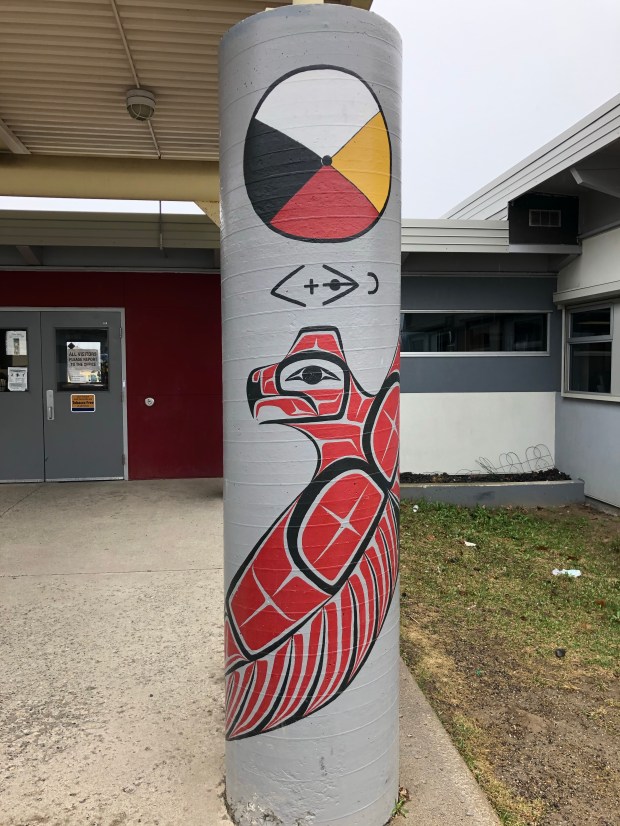
Medicine Wheel and Eagle

Once inside the building, I pass a white board on which a greeting message, changed daily, has ‘welcome’, the day and the month written in the Dakelh dialect.

Before turning the corner and entering my classroom, to shove my bags down and have a hurried cup of tea before the kids arrive, I pass three more pieces of First Nation art work depicting a frog, a caribou and a bear.

Welcome board

As the kids settle in we listen to the quintessential North American morning announcement over the public address system. As with many schools I have subbed in here, this begins with the Principle saying ‘Hadih’, which is Dakelh for Hello.

Unlike other schools, our Principle tells us the date by saying the day and the month, first in English then in Dakelh.

Frog and cariboo

Understanding the data

In any school the culture, religion and first language of the pupils reflects the demographic of that area. No matter where you teach, exploring this information helps you understand your pupils better.

Delving into the data, specifically the classifications, provided for pupils with indigenous ancestry reveals the on going legacy of a very out of date Act that you may have heard of, the 1876 Indian Act.

Data on Indigenous students will list them as either, ‘Métis’, ‘Status Indian’ or ‘Non-Status Indian’.

‘Métis’ is the term for people whose ancestry is mixed Indigenous and European.

‘Non-Status’ means that a person identifies as having indigenous ancestry, but does not have ‘status’. Often this lack of ‘status’ is because a female relative lost their right to their ‘status’ through marriage. Briefly, this happened to a woman because the terms laid out in the 1876 Indian Act meant her ‘status’ was determined by who her father was or who she was married to.

‘Status’ means that they have indigenous ancestry and are legally an ‘Indian’ under the terms of the 1876 Indian Act (and it’s subsequent amendments).

As a teacher here it’s important that to learn about these classifications and they how they impact the lives of the students, both those with First Nation and European ancestry, that I teach.

Indigenous Education Teams

Back to my school day. At some point one of my pupils is going to ask to go to the room where the Indigenous Education Team can be found. Sometimes they ask to go because they need some time out of the classroom to re-set, because they want to have a chat with a trusted adult or just because they need a snack.

These rooms always have enticing names names such as the ‘Wolf Den’ or the ‘Eagle Centre’. They sometimes have treadmills, exercise bikes or punch bags and they always have lots of art supplies and beautiful traditional art work adorning the walls.
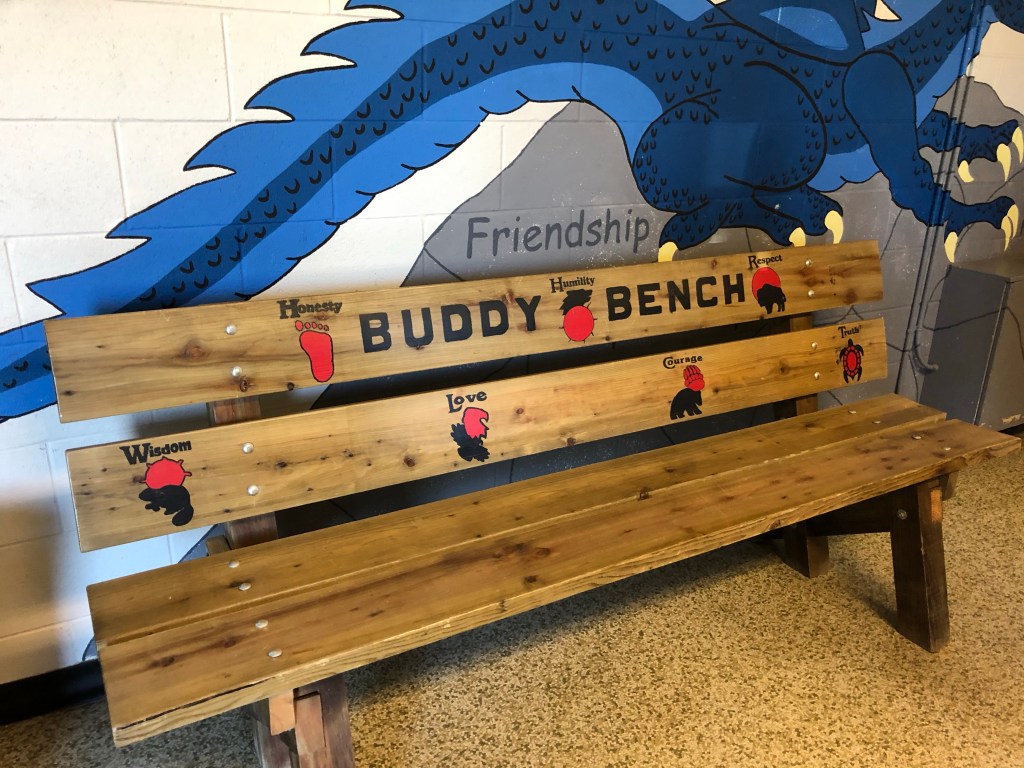
A bench showing the Seven Teachings

These rooms are always, without exception, in all schools, safe and ‘cool’ places where all pupils want to be and feel welcome. Undoubtedly, thererfore, meeting their aim of being places which reinforce pride, self esteem and a sense of community for First Nation pupils.

While the aim of the Indigenous Education Teams is to support First Nation pupils and their families, the reality is that they provide care for all pupils – and sometimes teachers – without distinction.

The day I forgot my flask of tea and one of my pupils asked to go our ‘Spirit Den’, then returned with a steaming hot hit of caffeine for her weary teacher proved that to me!

. . .

Check out Part two…

Part two: First Nation culture in the Canadian classroom

. . .

More about schools and teaching…

A guide to surviving as a British Secondary School Teacher in Canadian Elementary Schools
. . .

Enjoyed this? Subscribe and never miss a post…

A hike in a land formed by ice, to a canyon conquered by paddle steamers

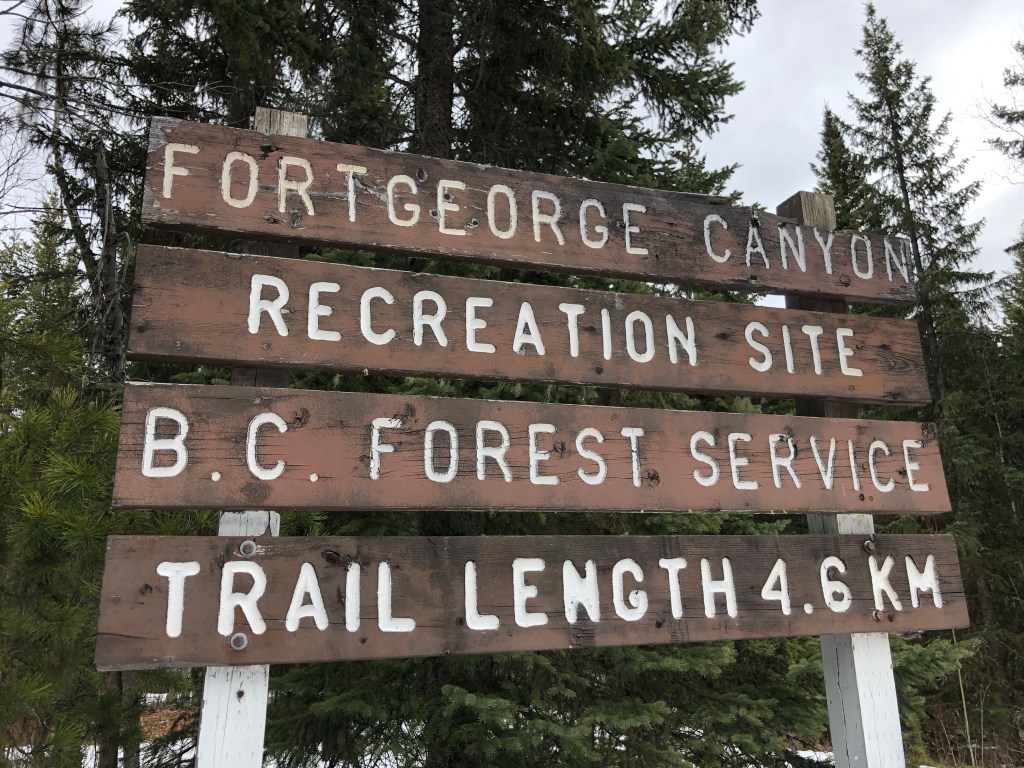
After an unexpectedly eventful beginning, the Fort George Canyon Trail offered some surprise lessons about this part of British Columbia.

An unforseen warm-up

Shoulder jammed into the number plate of a strangers car, with feet digging into the ground and pushing as hard as we could was not how we expected to start this hike.

None the less, that was where we found ourselves when we came across a group of hikers whose car had got stuck in the partially melted snow and mud in the single lane track that led up to the trail head.

Knowing that this could have easily been us, we dropped our rucksacks and got stuck in with the rescue mission. I offered some matting we had in our car to give the wheels traction and Jacob ran back to get it, while the rest of us dug the wheels out.

Car freed and feeling sufficiently warmed up, Jacob smiled and said “look at you, you loved that didn’t you?” Problem solving, with a team of strangers, in the back country, with no phone signal: what’s not to love?!

Hiking in a land carved by glaciers

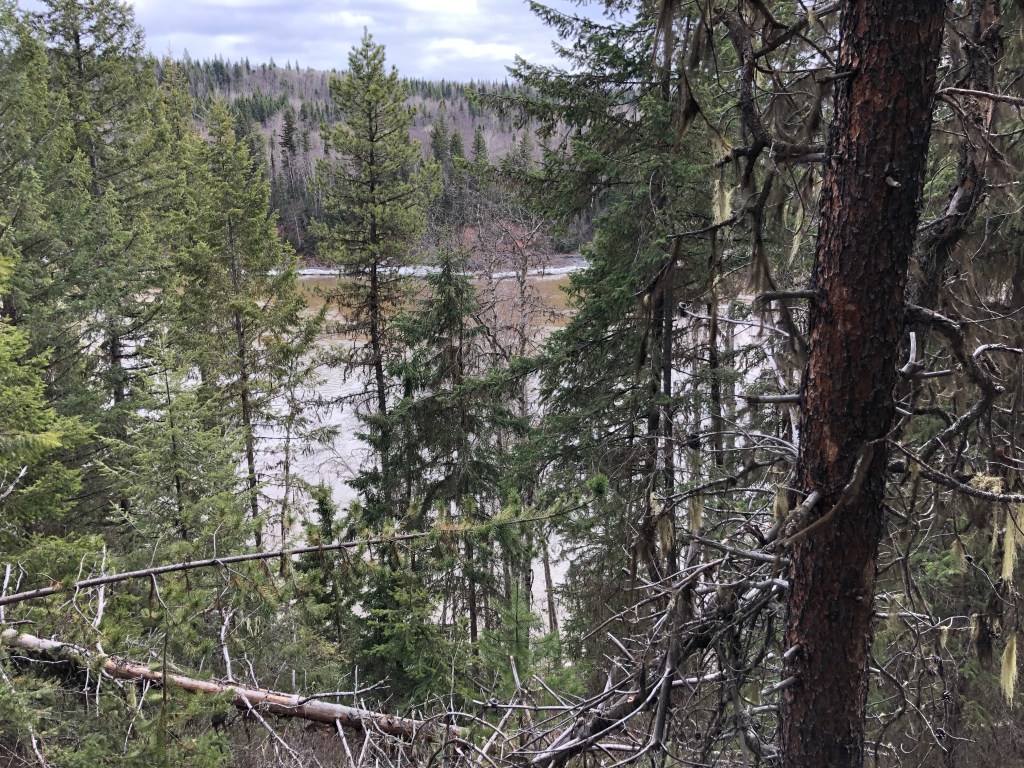
The first section of our trail was in a dense forest, through which the path weaved until we reached a more open area. To our left was a long, high hill. A very distinct feature in the landscape which was otherwise gently declining towards the river.

Jacob explained that these elongated, oval ‘hills’, called drumlins, are formed by the streamline movement of glacial ice sheets. Staring at this ‘drumlin’ I could not picture the gigantic ice sheet which would have covered most of British Columbia.

We paused our hike so Jacob could show me what this area looks like on Google Maps. Immediately you can spot thousands of drumlins scaring the landscape; gigantic tear drops all moving in the same direction. Suddenly, the gigantic ice sheet, and the way the drumlins show the direction of the ice flow, was much easier to picture.

The Fraser
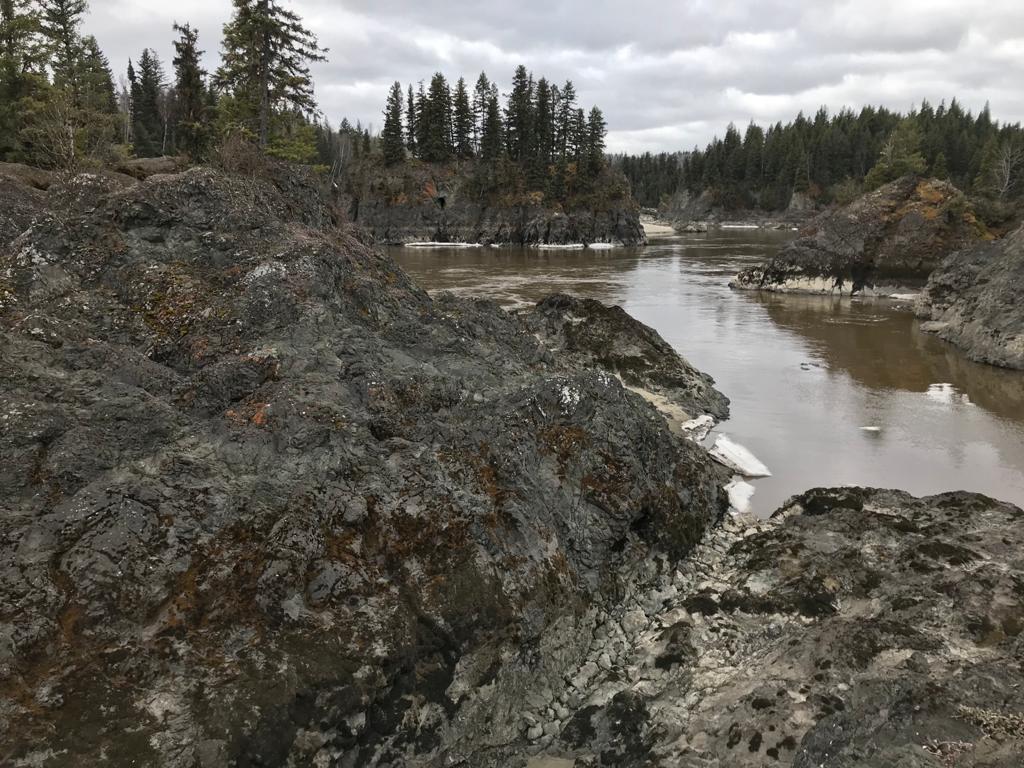
Fort George Canyon

A canyon with a hidden history

Before long, the trail led us back into a forested area and then, after a while, more noticeably downhill towards the river and the canyon. As we approached the ‘beach’ an information sign with the title ‘The BX’ caught my eye because we had enjoyed a beer with friends in a pub called ‘The BX’ a few days earlier.

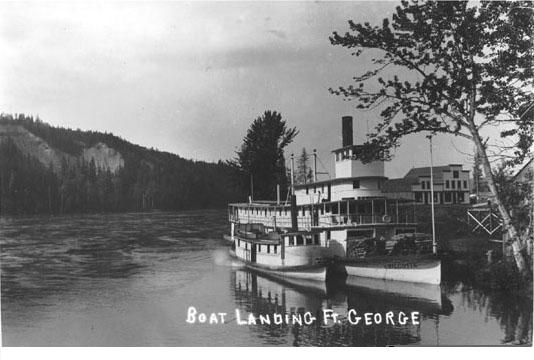
The sign explained that The BX was a stern wheeler, a type of paddle steamer, which carried people and goods up and down the Fraser river. The BX was one of twelve paddle steamers on the Fraser between 1863 and 1921.

When these boats reached Fort George Canyon, where we now stood looking out over the rocky islands, the passengers had, by law, to disembark because the Canyon’s large rocks and rapids commonly damaged and wrecked boats.

A Paddle Steamer arriving at the area known as Prince George today.
This Canadian work is in the public domain in Canada due to it’s age.
A Paddle Steamer on the Fraser River.
This Canadian work is in the public domain in Canada due to it’s age.

Jacob disappeared following the path of a Bald Eagle towards the islands, leaving me to get lost in thoughts of those paddle steamer passengers. It was easy to imagine them, tried from the journey, disgruntled at having to get off and walk. Nervously watching their paddle steamer battle the canyon before they were able to board it again for their journey onto Fort George.

It is no wonder The BX has been immortalised as the name of one of Prince George’s pubs. It became a popular choice of vessel after it proved to be so safe that it was allowed to travel through Fort George Canyon with passengers on board.

We left the canyon and regained the trail, grateful for the unexpected lessons it had given us; but also grateful that our biggest challenge today had been freeing a car from snow rather than a paddle steamer from a canyon.

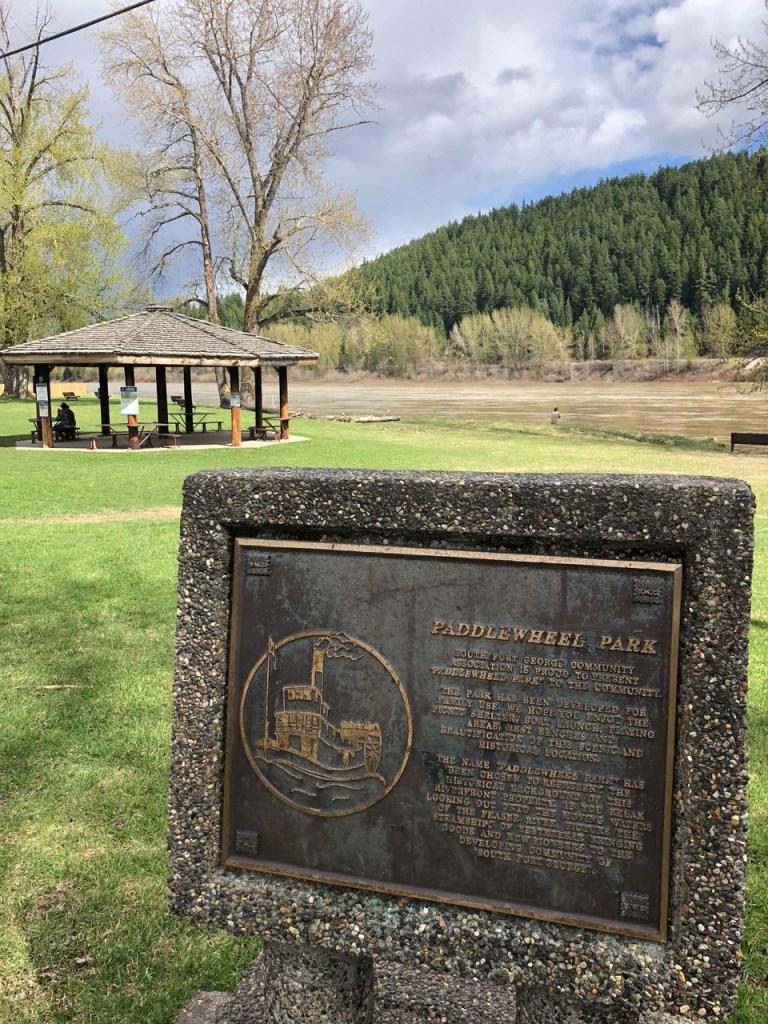
A few weeks later we visited Paddle Steamers Park in the centre of Prince George. The small park marks where passengers, who had safely travelled up the Fraser and though Fort George Canyon, would have disembarked in the area known then as South Fort George.

. . .

Come on another hike with us…

A teapot for a birthday: A spring hike in Bear Country

A snowy day hiking in the footsteps of First Nation traders and conquering my fear of the cold

Discover more about the history of Prince George…

First Nation, Fur Trade and a Train Station: How Prince George became a city.

. . .

Receive email updates and never miss a blog…

Chasing the Aurora Borealis in Northern British Columbia

Prince George has a winery, a DJ and even a denture clinic named after the spectacle. Tantalising photographs of the Northern Lights, taken locally, are regularly shared online. At 53° north, our chances seem good.

But will we be treated to the greatest show on earth during our time here?

A cold evening in December

This story starts in late December 2020. My Aurora app notified me of possible activity that evening and so we decided to don our thermals and head out.

We drove north out of the city but immediately ran into difficulty: Ice was rapidly building up on the inside of our old, poorly heated SUV and the windscreen was becoming dangerously close to opaque!

Thus began a mad drive when I would scrap enough ice away for Jacob to be able to safely see out, give my wrist a break and scan the sky for the Northern Lights, then resume scrapping once the ice had built up again.

Eventually we opened the windows, somewhat solving the problem by allowing our warm breath to escape. Though cold, this method did mean we could actually see the two moose we encountered. Which was a good job as the first one ran out in front of our car (more about that experience here)!

No Northern Lights, but two beautiful moose. Not bad for a first go.

A freezing evening in February

You may remember from this post that we endured a week in February when temperatures plummeted to around -30C. Though it was, without a doubt, a stupid idea, we went out one evening that week after another notification said the Aurora may be active.

With flasks of hot drinks, snacks, blankets, a new plug-in car heater and wearing so many layers walking was difficult; we ventured out into the night and found a dark spot in an area called Salmon Valley, about thirty minutes outside of Prince George.

Our dark spot was incredible and, while there was no sign of the Northern Lights, we stayed for a while and enjoyed the pitch black sky littered with more stars than I’ve seen visible since a trip to Africa.

After standing on the roadside star gazing, letting the cold (did I mention it was around -30C?!) creep through your clothes and chill your bones, it was an unpleasant ride home.

No Northern Lights but an immense display from the stars (and thankfully we returned with all our fingers and toes).

A warm evening in April

There had not been a cloud in the sky all week and we had been enjoying some unexpectedly hot weather for Spring. However, we had no plans to be out that evening until my friend Lindsay (you can meet her in this adventure) text me the following magic words: ‘guys look to the north, it’s the northern lights’.

Wearing pyjamas and a dressing gown, I grabbed my coat, Jacob grabbed the car keys and we jumped in the car to drive north. Before we even reached the end of our street we spotted a green haze in the sky and realised, in utter disbelief, that the Aurora Borealis was right here in the city.

After thirty exciting minutes of driving toward a changeable, misty green sky, we were in the perfect spot, on the side of a road, in the pitch black with a wide open view of the northern sky.

When we first got out of the car the Aurora was a thin, green streak in the sky. It looked like a luminous green shepherds hook laid on it’s side, the crooked end of the hook was particularly misty and a vibrant green.

Slowly before our eyes the Aurora changed: from a sliver with a hooked end, it become thicker, filling more of the sky. Most of the misty streaks were horizontal but occasionally there were vertical streaks which came and went. Like the beam of a UFO or a spotlight on a stage. These streaks had a wispy quality, lasting only a few moments before disappearing.

Sometimes it would visibly flicker and changed before our eyes. These were the moments, when Jacob and I would turn to each other and say “did you see the red?”, “did you see the blue?”; because it was during these momentary flashes that other colours would appear in the pulsating green, so fast you barely believed you had really seen them.

After a while, perhaps because our eyes had adapted, the whole of the northern sky was filled with a smokey, green glow and the brighter streaks rippled on top of this background.

Eventually we drove back into the city. The roadsides were lined with people who, like us, had dashed out of their houses and driven north. As we discovered later, Aurora displays this good, where you can see the colours with the naked eye, are actually extremely rare. Therefore, even in northern British Columbia, where this unpredictable and illusive show is relatively common, this was a remarkable evening.

When we arrived home we rushed upstairs and to our amazement the sky from our upstairs windows was restless and green. We slowly got ready for bed rushing back every few minutes to check what it was doing, how it had changed and whether it had gone away.

Of course, seeing the Northern Lights in a wide open, dark sky as it swirls and sparkles is mesmerising. But there is something really special about being in your own home, doing your normal night time routine, while the otherworldly, mysterious Aurora dances outside your window.

As Jacob said in disbelief, summing up our luck and gratitude succinctly, “I’m cleaning my teeth looking at the Northern Lights”!

Photographs

Here and here are Instagram accounts where you can see photographs taken in and around Prince George that night. Look for the photos taken on the 16th April 2021 and you will get a sense of what we saw. Being a unique display, local news also covered it, check out this article and this one for more photographs.

. . .

Read more about life in Northern British Columbia…

Fall in Northern British Columbia: Warm days, amber leaves and Pumpkin Spiced Lattes

Prince George: The armpit of British Columbia or British Columbia’s best kept secret?!

“My finger tips started to stick to the glass”… and other lessons I’ve learned about surviving winter in Canada.

. . .

Subscribe and never miss a blog…