This totally useless (but hopefully amusing) guide covers everything you really don’t need to know about how to survive as a substitute teacher in Canadian elementary schools, if all your prior experience is in a British secondary school teaching History. In this guide I’ll share some highlights and some things I’ve learned – from which words to avoid saying, to the laws of the snowy playground – during my first term teaching in British Columbia, Canada. These experiences reveal some of the language and cultural differences between Southern England and Northern British Columbia, Canada.
There are 8 secondary schools in Prince George and 31 elementary schools, so due to the nature of probability I have not been sent to a single Secondary School to cover absent teachers during my first term here. Thankfully, I have had lots of work in the elementary schools and it has been a fascinating experience.
Things are going to be a little different next term – read on for more about that exciting news in a moment – so I thought now was a good time to share a few of my experiences with you in the form of a guide covering language, clothing, playtime rules and culture.
…
Language
First things first, as a traveller from distant lands you’re going to need to address that ‘BBC accent’ unless you want to have kids asking: “ do you speak Spanish?” and even “What world are you from?”. These are both questions I have genuinely been asked. But my personal favorite was overhearing one worried child ask the Teaching Assistant “What’s wrong with her, can’t she speak English?”
Once you’re over the shock that a pupil could think that you can’t speak English, you’re going to need to work on your vocabulary. If you think it will be easy because there is no language barrier, then use the word ‘toilet’ in front of 30 Canadian kids and you’ll see. Try ‘washroom’ instead, it induces less giggles.
Some words are just slight tweaks which you may assume will be fine, such as the difference between maths and math and sledge and sled. And it is fine, if you want fifteen seven years olds putting their hands up to inform you that you are saying the word wrong for Math.
You may not like it, but the quickest and easiest thing to do is to adopt a whole new vocabulary for when you’re in school. Here are a few words to get you started: recess instead of playtime, swap hat for tuque, replace bin with garbage and try gym rather than P.E. Be warned it’s not just the pupils who will give you a blank stare if you use the wrong word. I once completely failed to get the information I needed from another teacher because I kept asking where I needed to be ‘on duty’ rather than ‘on supervision’.
Sometimes its not what you say, but how you say it that is going to cause problems. Taking the attendance (note another word substitution there: ‘attendance’, not the ‘register’) in one school I called ‘Lawson’ and the child insisted I had not said his name right. Thinking it was not exactly a difficult name and perhaps he just had not heard me correctly, I said it again. Nope, he was still not happy. I tried again, this time imitating a Canadian accent by making the ‘la’ long and sort of dropping the ‘w’ a bit, rather than pronouncing ‘law’ fully. Finally, he was satisfied!

Clothing
The first big difference regarding attire that you are going to notice is that the pupils are wearing their own clothes. You are unlikely to notice anything remarkable about the impact this has on behaviour etc with the younger pupils. It’s not until humans get a little older that they start expressing themselves through their clothes. That said, hats (tuque) may be a stumbling point. Don’t assume that they are expected to take them off during lessons. I certainly did during my first few days, only to learn that many teachers allow baseball caps in the classroom and by asking them to remove them I was picking battles I could not win.
As an elementary teacher you will need outdoor and indoor shoes. You will need a warm coat, gloves and a hat (tuque). Don’t be a fool and think playtime (recess) is short I’ll manage. You won’t. You will be standing in deep snow while the kids play, you will need snow boots and warm socks. But please note: once inside you will be warm, very warm and so you’ll need summer shoes. No, a decent pair of boots will not cover both, are you joking? With all this layering up and stripping off you better end Maths (Math) ten minutes early. It takes time, lots of time for the little ones to get ready. On the bright side because they are already in comfy clothing they don’t get changed for P.E (gym), so that is much faster.
Playtime Rules
As a secondary school teacher, if no one is punching each other and no one is smoking, you have done your job on duty (supervision). In the elementary schools here (and I’m sure it is the same in British primary schools) you need to be a little more aware of the nuance of the playground rules. But what is different in Canadian elementary schools to British primary schools is the laws around snow. The pupils are going to go outside in temperatures that would close schools in the U.K, so you better be ready to be the judge and jury of the playground in these tough conditions. Here are a few pointers to help you out as you stand in the freezing cold, watching kids hurtle themselves down snow piles.
1. If you didn’t build the snowman/snow structure don’t destroy it. This rule is universally in place across all the schools I’ve been in and stops squabbles over who destroyed whose snowman.
2. No going on the snow piles without snow pants. In one school I was in, the playground was dotted with giant piles of snow which had been left there after the pathways had been cleared. For some reason rather than ban pupils from these ice mountains, they were allowed to climb all over them on mass. Each snow pile was crawling in multiple pupils fighting their way to the top, at which point they would throw themselves down its steepest, most slippery side. But only if they were wearing snow pants, that known protector from a broken arm!
3. Careful on the ice. Seriously. Not don’t go on the ice, just be careful. Naturally this lead to an entire playtime (recess) spent with my heart in my mouth watching kids face plant.
4. Keep out of the forest in high winds. At a couple of the schools on the outskirts of the city the playgrounds are partially forested. At playtime (recess) the pupils (who are taught what to do if a bear appears in the summer months) have free reign to run wild amongst the trees. I was in one such school on a windy day, after a large snow dump and the pupils were told to keep out of the forest encase the wind blew a large amount of snow out of the trees and on to their heads!
5. Only school sledges to be used at recess, you can’t bring your own. I noticed a stack of colourful, large sheets of plastic hanging by the door in one school and discovered that they were sledges (sleds) for the kids to use. I thought this was amazing, but one boy spent ten minutes moaning to me about the fact that they were not allowed to bring in their own sledges (sleds) from home.
6. Sliding hill is for sliding, not sledging. Quite a few of the schools I’ve been to have hills in their playgrounds and so they have the perfect natural slide for winter fun. With the snow packed down from usage they run, jump and fly down these smooth, ice slides. They look like deathtraps to me, but apparently so long as they only slide and don’t sledge (sled) down them they are following the school rules!
Culture
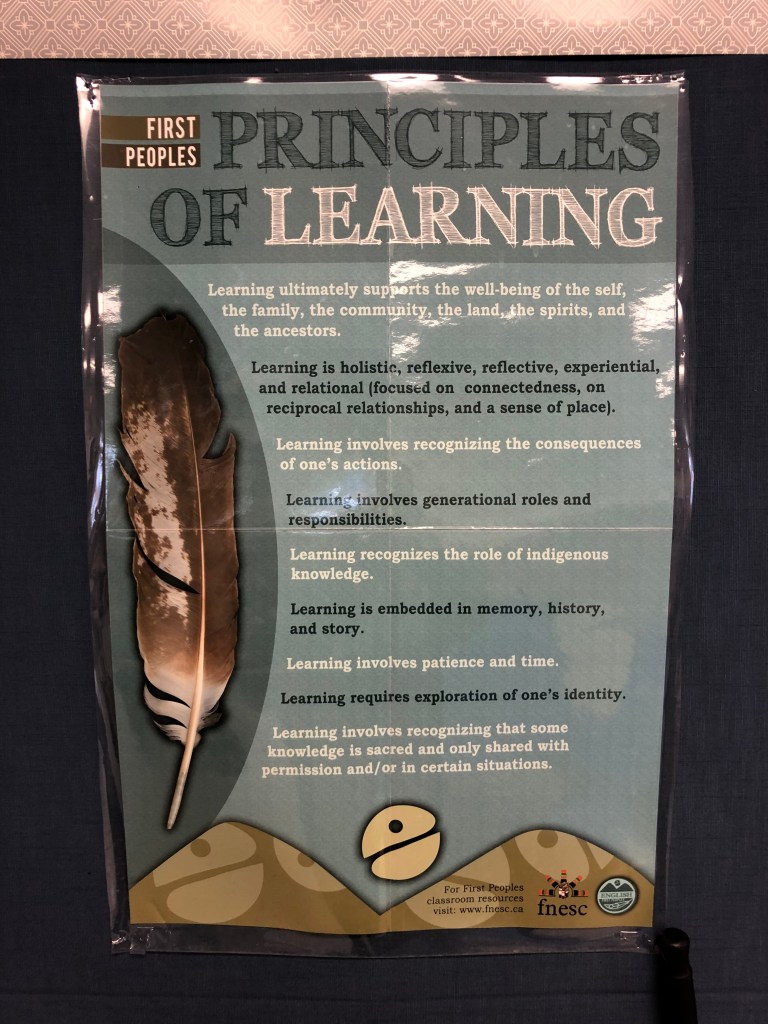
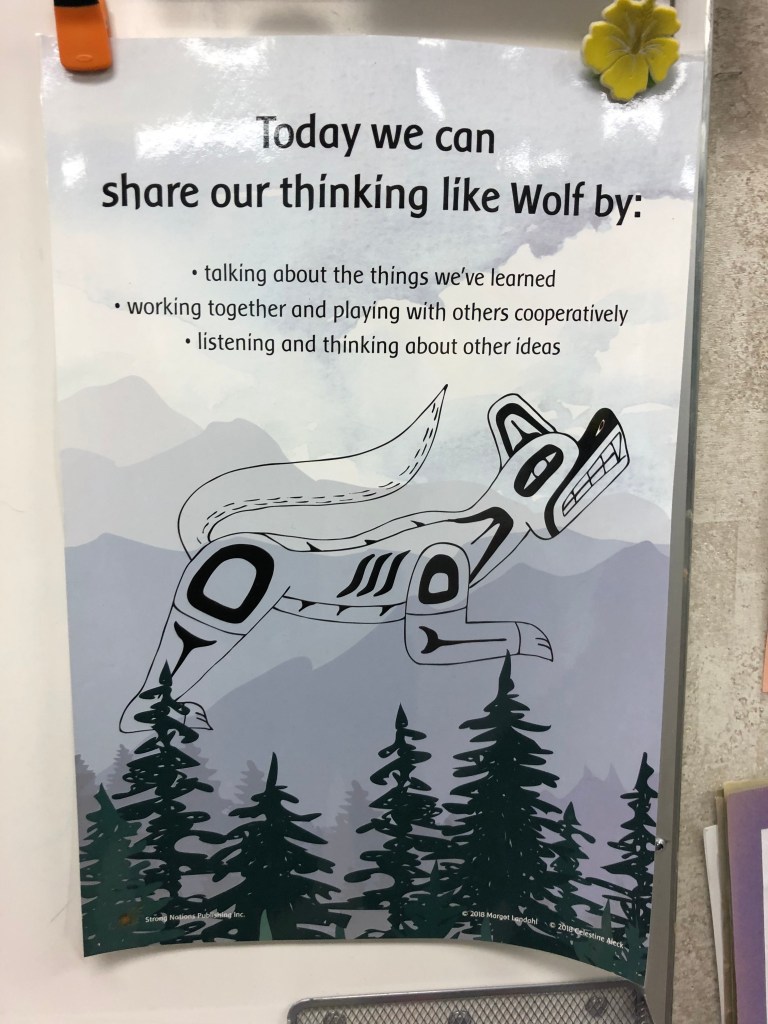
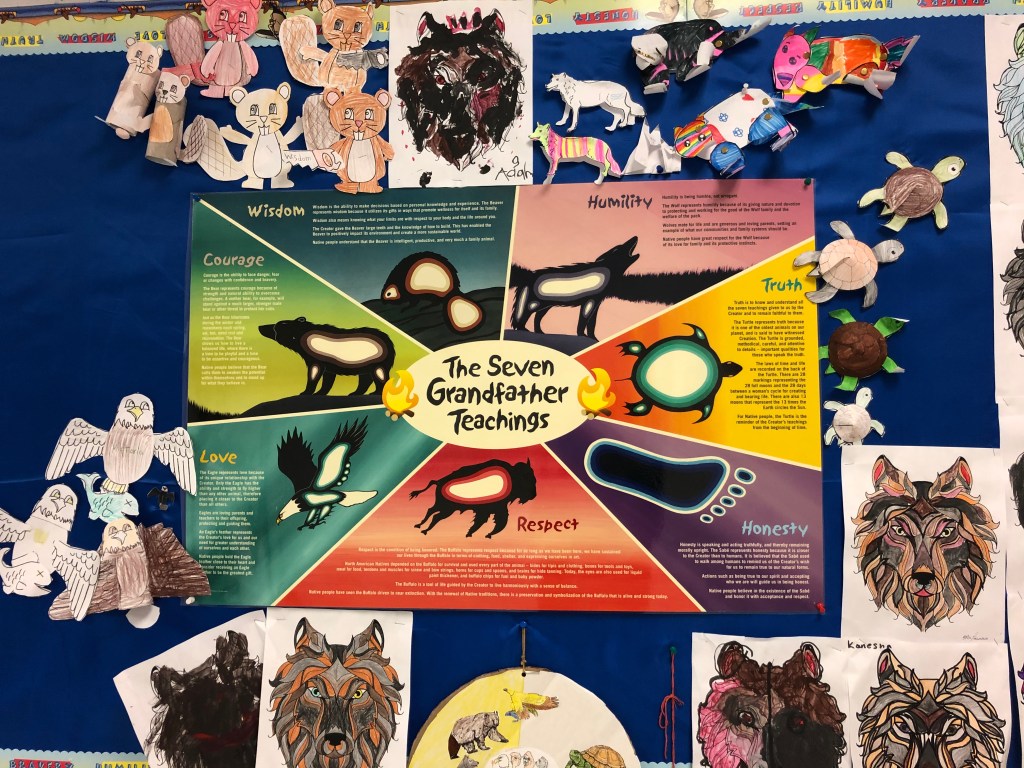
One of the most unique things about being a substitute teacher here in Prince George is the opportunity to experience the local First Nation culture. You will learn a great deal from the First Nation pupils you meet every day (25% of the students here are FN), the Indigenous Education Team in each school and, if you are lucky, the Elders who come in to run workshops while you are there. People pay a lot of money to have a ‘genuine’ First Nation tourist experience, but by teaching here you will learn bits of the Dakelh language and the Seven Grandfather Teachings as they are weaved into every school day. If you are sent to cover a teacher at Nusdeh Yoh Elementry School (meaning House of the Future), the First Nation choice school, your day will begin with drumming rather than a school bell and you’ll sing entire songs with the class in the Dakelh language.
The cultural experiences won’t end there, each kid here will teach you something. Just ask them about their favourite sport, they are Ice Hockey champs and accomplished Figure Skaters. They will love telling you about weekends at the lake and afternoons on a Ski-Doo. One gentle five year old boy spun a yarn all about a Brown Bear who kept returning to this one bush in his garden to feast on the berries. How lovely, I was thinking, they get to see such amazing wildlife. Then the young chap ended his tale by saying ‘we had to shoot it, it just kept coming back’.
You may find that there are little moments where your previous experiences unexpectedly help you out in the classroom here. Having just spent five years in a London secondary school where many of the student’s families were from India, meeting pupils in Prince George with names such as Jaskaaran, Jasmeh and Gulshandeep gave me a rush of familiarity. It was also really amusing to watch these kids confused faces when I stumble over other names, but not theirs!

…
I hope this guide helps you and if not (I imagine not!) then I’m hope it has amused you!
It’s been really interesting and often hilarious navigating being a British secondary school History teacher working in Canadian elementary schools here in British Columbia, but for the moment that has come to an end. Just before the end of term I was appointed to a position working as a Special Needs Teacher in Prince George Secondary School for the Spring Term. So its back to the teenagers for me for now!

 West Country Wandering
That was fascinating Helen. I really had no idea about where you were or what it was like but you really bought it to life in your blog! Good luck with the new job; which will bring all its own special challenges by the sound of it.
LikeLiked by 1 person
Absolutely amazing H and very interesting. Let us know about your knew job when you can!
LikeLike
What an amazing culture shock! I loved reading about your experiences in the playground (is that the right word?) I laughed and laughed. All that snow, for months and months. It’s not surprising that break (recess!) is very different from anything you’ve experienced before. Good luck in your new job. xxx
LikeLike
very very interesting and informative!
LikeLiked by 1 person
Fantastic update , best yet! 😊
LikeLike