This is part one of a blog about the things I have been privileged to learn and experience, as a teacher in Prince George, about a culture that is alive, vibrant and being celebrated in schools.
Part two of this blog can be found here.
Land acknowledgement
We respectfully acknowledge the unceded ancestral lands of the Lheidli T’enneh, on whose land we live, work and play.
Lheidli T’enneh hubeh keyoh whuts’odelhti. Nts’ezla hubeh yun ts’uwhut’i, ts’uzt’en ink’ez ts’unuwhulyeh.
A few facts
- Prince George is on the unceded ancestral home of the Lheidli T’enneh, a sub-group of the Dakelh who are the indigenous people of a large area of British Columbia.
- Around 30% of the students in School District 57 – 3,651 pupils – are First Nation.
- British Columbia’s curriculum was recently redesigned to integrate Indigenous knowledge and perspectives into all subjects, at all grades levels (year groups).
First Nation Culture in my morning routine
When I shut my car door each morning and walk, bleary eyed, towards the Elementry School where I am currently teaching, the first site I am greeted with is two large, bright eagles painted in the traditional style on the pillars beside the front door.
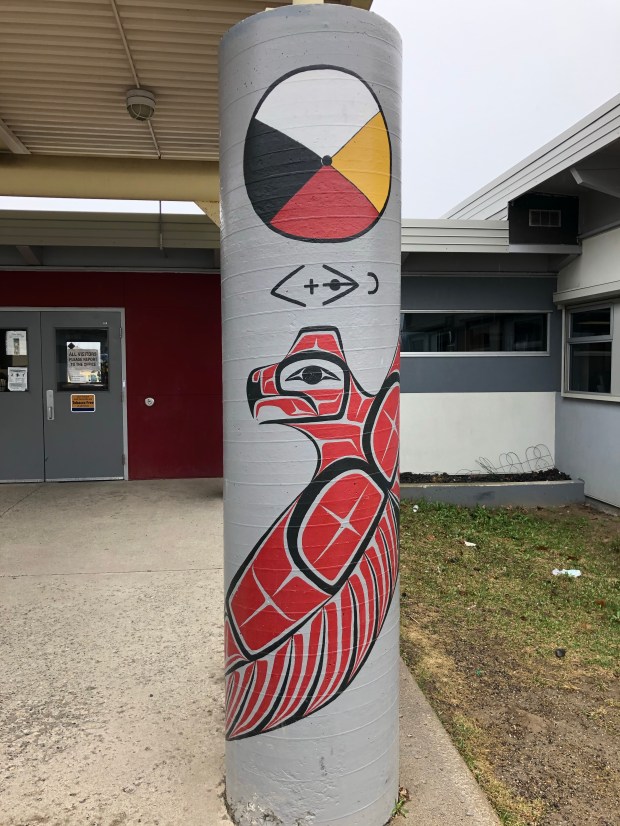
Once inside the building, I pass a white board on which a greeting message, changed daily, has ‘welcome’, the day and the month written in the Dakelh dialect.
Before turning the corner and entering my classroom, to shove my bags down and have a hurried cup of tea before the kids arrive, I pass three more pieces of First Nation art work depicting a frog, a caribou and a bear.

As the kids settle in we listen to the quintessential North American morning announcement over the public address system. As with many schools I have subbed in here, this begins with the Principle saying ‘Hadih’, which is Dakelh for Hello.
Unlike other schools, our Principle tells us the date by saying the day and the month, first in English then in Dakelh.

Understanding the data
In any school the culture, religion and first language of the pupils reflects the demographic of that area. No matter where you teach, exploring this information helps you understand your pupils better.
Delving into the data, specifically the classifications, provided for pupils with indigenous ancestry reveals the on going legacy of a very out of date Act that you may have heard of, the 1876 Indian Act.
Data on Indigenous students will list them as either, ‘Métis’, ‘Status Indian’ or ‘Non-Status Indian’.
‘Métis’ is the term for people whose ancestry is mixed Indigenous and European.
‘Non-Status’ means that a person identifies as having indigenous ancestry, but does not have ‘status’. Often this lack of ‘status’ is because a female relative lost their right to their ‘status’ through marriage. Briefly, this happened to a woman because the terms laid out in the 1876 Indian Act meant her ‘status’ was determined by who her father was or who she was married to.
‘Status’ means that they have indigenous ancestry and are legally an ‘Indian’ under the terms of the 1876 Indian Act (and it’s subsequent amendments).
As a teacher here it’s important that to learn about these classifications and they how they impact the lives of the students, both those with First Nation and European ancestry, that I teach.
Indigenous Education Teams
Back to my school day. At some point one of my pupils is going to ask to go to the room where the Indigenous Education Team can be found. Sometimes they ask to go because they need some time out of the classroom to re-set, because they want to have a chat with a trusted adult or just because they need a snack.
These rooms always have enticing names names such as the ‘Wolf Den’ or the ‘Eagle Centre’. They sometimes have treadmills, exercise bikes or punch bags and they always have lots of art supplies and beautiful traditional art work adorning the walls.
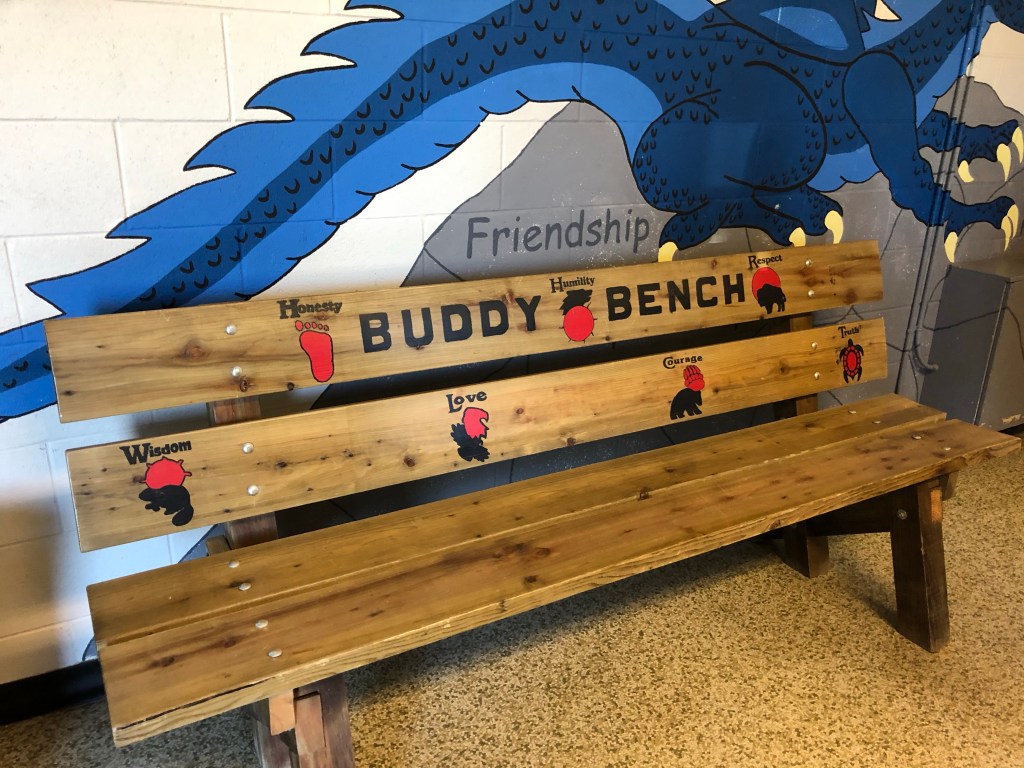
These rooms are always, without exception, in all schools, safe and ‘cool’ places where all pupils want to be and feel welcome. Undoubtedly, thererfore, meeting their aim of being places which reinforce pride, self esteem and a sense of community for First Nation pupils.
While the aim of the Indigenous Education Teams is to support First Nation pupils and their families, the reality is that they provide care for all pupils – and sometimes teachers – without distinction.
The day I forgot my flask of tea and one of my pupils asked to go our ‘Spirit Den’, then returned with a steaming hot hit of caffeine for her weary teacher proved that to me!
. . .
Check out Part two…
Part two: First Nation culture in the Canadian classroom
. . .
More about schools and teaching…
A guide to surviving as a British Secondary School Teacher in Canadian Elementary Schools

 West Country Wandering
You are sharing such new information for me it’s been such a relief to become aware that the indigenous culture has not disappeared- I honestly had no idea. I felt there would be tiny fragments of the First Nation culture left and now hope those fragments aren’t so tiny. So now I’m looking forward to seeing Canada even more ! Brilliant Blog Ha Ha xx
LikeLike
always interesting H. Love Pops1!
LikeLike